
Polypharmacy Risk Estimator
Patient Profile
Relative Fall Risk Increase
0%
Compared to baseline (< 4 meds)
Hospitalization Probability
0%
Likelihood of med-related admission
Assessment Status:
--Impact of Deprescribing
If you safely reduced your medication count to a target number:
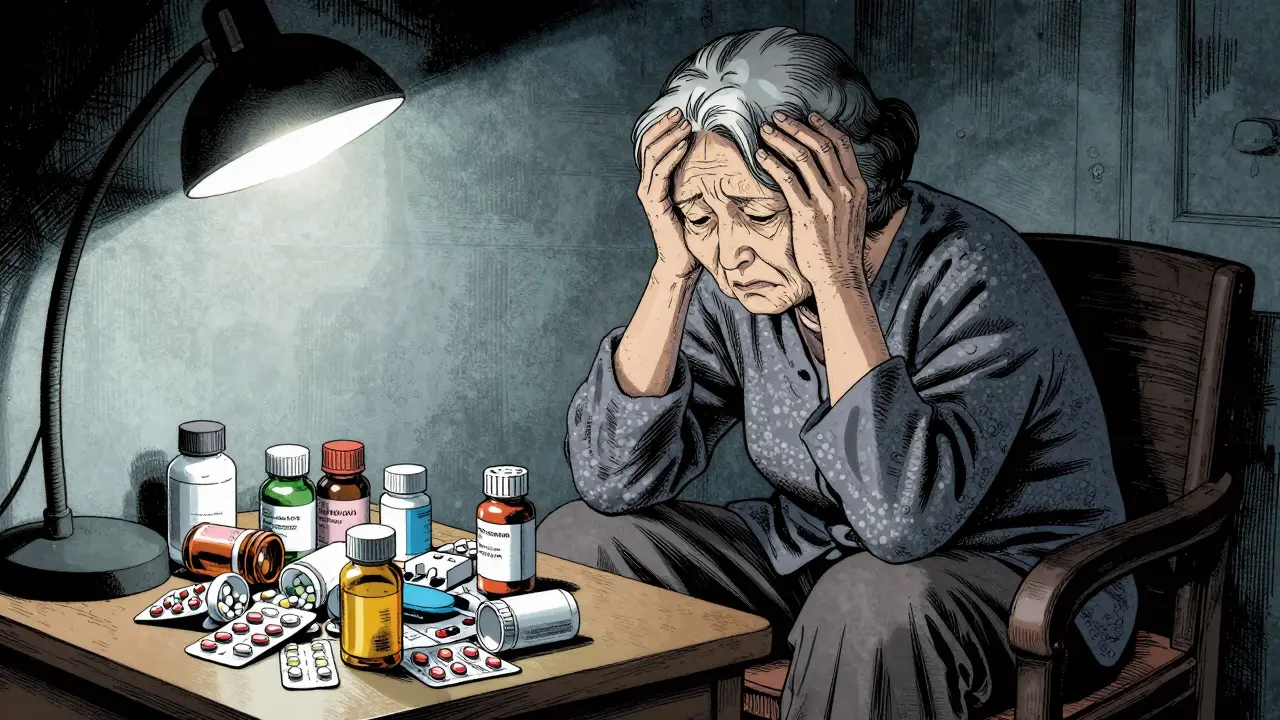
Imagine a patient named Martha. She is 78 years old, lives alone in Melbourne, and manages arthritis, high blood pressure, diabetes, and anxiety. Her medicine cabinet holds twelve different pills. Some were prescribed by her GP, others by her cardiologist, and a few by a specialist she saw once three years ago. Martha feels dizzy often. She falls twice a year. She wonders if the pills are helping or hurting.
Martha’s story is not unique. It represents a growing crisis in healthcare known as polypharmacy, defined broadly as the routine use of five or more medications simultaneously. While no single definition fits every case, the threshold of five drugs is widely accepted in clinical practice and research literature. The danger isn't just the number of pills; it's the complex web of interactions, side effects, and cumulative risks that come with them. For older adults, particularly those aged 65 and above, this complexity leads to preventable harm, hospitalizations, and a diminished quality of life.
The Hidden Risks of Multiple Medications
Why is taking many medications so dangerous for older adults? The human body changes as we age. Kidneys filter slower, livers process drugs less efficiently, and body composition shifts, altering how medicines are absorbed and eliminated. When you add multiple drugs into this changing system, the risk of adverse drug events (ADEs) spikes dramatically.
Research published in the Journal of the American Geriatrics Society (2018) shows that patients taking more than four medications face a 30-50% higher risk of injurious falls. Each additional medication increases fall risk by approximately 8%, regardless of the drug class. This isn't just about tripping over rugs; it's about sedation, dizziness, and orthostatic hypotension caused by blood pressure medications interacting with painkillers or antidepressants.
Beyond falls, polypharmacy drives hospital admissions. According to the Institute for Safe Medication Practices (2022), medication-related issues account for roughly 27.7% of all hospital admissions among older adults. These aren't minor visits; they are costly, traumatic events that often lead to further functional decline. In the United States, where the population aged 65+ is projected to reach 80 million by 2040, the economic burden is staggering-approximately $30.1 billion annually, with 61% tied to preventable hospitalizations.
Types of Interventions: What Actually Works?
Not all attempts to fix polypharmacy are created equal. A systematic review methodology classifies interventions into three distinct levels, but only one has proven consistently effective in reducing serious outcomes like hospital readmissions.
- Type I: Prescription List Review Only. A clinician looks at the list of drugs. It’s quick, but it misses context. Research shows this type has little to no impact on clinical outcomes.
- Type II: List Review Plus Adherence Assessment. This adds a check on whether the patient is actually taking the meds. Better, but still insufficient for complex cases.
- Type III: Comprehensive Medication Review (CMR) with Face-to-Face Consultation. This involves a detailed conversation with the patient, evaluating both medications and underlying clinical conditions. A study in JAMA Network Open (2023) found that Type III interventions reduced unplanned hospital readmissions by 18.3% compared to standard care. Types I and II showed no statistically significant benefit.
The key difference? Human connection and clinical judgment. A pharmacist or doctor sitting down with Martha, asking why she takes each pill, checking for side effects, and aligning treatments with her personal goals makes all the difference. In 2025, 75% of these effective pharmacist-led visits were conducted via telehealth, proving that virtual care can be just as powerful if done correctly.
Tools for Safer Prescribing
Clinicians don’t have to guess which drugs are problematic. Several validated tools help identify inappropriate prescribing in older adults. However, not all tools perform equally well in real-world settings.
| Tool Name | Publisher/Year | Key Focus | Clinical Impact Evidence |
|---|---|---|---|
| Beers Criteria | American Geriatrics Society (2023) | List of potentially inappropriate medications (PIMs) | Widely used for screening, but less evidence for direct outcome improvement without comprehensive review |
| STOPP/START Criteria | European Geriatric Medicine (v3, 2021) | STOPP: Stop Potentially Inappropriate Prescribing; START: Start Recommended Treatments | Demonstrated positive impacts on clinical endpoints in randomized controlled trials |
| FORTA List | German Society of Internal Medicine | Fit fOR The Aged: Prioritizes essential vs. optional meds | Showed positive impacts on clinical endpoints in RCTs |
The STOPP/START criteria stand out because they address two sides of the coin: stopping bad drugs and starting missing ones. Dr. Joseph T. Hanlon from the University of Connecticut emphasizes that 38.7% of older adults experience undertreatment alongside inappropriate polypharmacy. You can’t just cut pills; you must ensure necessary therapies remain intact.

The Role of Deprescribing
Deprescribing is the planned and supervised process of dose reduction or withdrawal of a medication that may cause harm or is no longer beneficial. It is the core action within effective polypharmacy interventions. But it is risky if done poorly.
Dr. Dan Berlowitz warns in the Journal of General Internal Medicine (2023) that aggressive deprescribing without proper monitoring increases the risk of therapeutic abandonment. His team documented that 7.3% of patients experienced disease exacerbation after inappropriate discontinuation of essential medications. For example, abruptly stopping beta-blockers for heart failure or benzodiazepines for anxiety can be life-threatening.
Successful deprescribing requires:
- Accurate Medication Lists: Secure what the patient is actually taking. Discrepancies between pharmacy records, EHRs, and patient reports are common.
- Goal Alignment: Discuss life expectancy and quality-of-life goals with the patient. Does Martha want to live longer, or does she want to feel better today?
- Gradual Tapering: Slowly reduce doses to monitor for withdrawal symptoms or rebound effects.
- Monitoring: Follow up closely after any change.
Pharmacist-led interventions under Collaborative Practice Agreements (CPAs) have shown great promise. A 2025 study in Tandfonline found these teams achieved 37.6% higher deprescribing rates than physician-only approaches. However, access remains uneven, with limited CPA availability in many U.S. states.
Implementation Challenges and Solutions
Even with clear evidence, implementing polypharmacy interventions is hard. Why? Time, money, and fragmented care.
Primary care physicians report having less than 5 minutes per patient for medication reviews (AAFP, 2022). Yet, a thorough reconciliation takes an average of 22.7 minutes (University of Michigan, 2023). Adding a STOPP/START assessment adds another 15-20 minutes. Who pays for this time? Currently, only 15% of Medicare Advantage plans provide specific payment for comprehensive medication reviews (KFF, 2023).
Fragmentation is another hurdle. The Agency for Healthcare Research and Quality (AHRQ) reports that 78.3% of older adults see five or more providers annually. Without integrated electronic health records (EHRs) that share data seamlessly, clinicians work in silos. Only 32.7% of EHRs systematically track adherence, making it hard to know if a drug is failing due to inefficacy or non-compliance.
Success stories exist. The Veterans Health Administration’s Geriatric Research, Education and Clinical Centers (GRECCs) achieved a 26.8% reduction in potentially inappropriate medications through embedded pharmacist programs. Academic medical centers with geriatrics-trained pharmacists report 42.6% higher resolution of drug-related problems compared to general primary care.

Future Directions: AI and Personalized Care
Technology is evolving to support clinicians. In April 2024, Epic Systems launched a 'Polypharmacy Risk Score' tool. Validated in JAMIA (2024), it predicts adverse drug events with 87.3% accuracy. Such artificial intelligence tools can flag high-risk combinations before prescriptions are written, acting as a safety net.
The American Geriatrics Society is developing Beers Criteria v2026, expected in Q3 2025, with a focus on deprescribing algorithms. Meanwhile, researchers are exploring personalized risk calculators incorporating genomic data to predict individual drug metabolism.
Regulatory pressure is also shifting. CMS incorporated polypharmacy metrics into the Merit-Based Incentive Payment System (MIPS) starting in 2024, penalizing providers with over 30% of Medicare patients on ten or more medications. This financial incentive aligns with value-based care models that reward health outcomes over volume of services.
Practical Steps for Patients and Families
If you or a loved one manages multiple medications, take action now:
- Create a Master List: Include prescription drugs, over-the-counter meds, supplements, and herbal remedies. Update it every month.
- Ask for a Review: Request a Comprehensive Medication Review (Type III) with your pharmacist or doctor. Ask specifically: "Is this medication still necessary?" and "What are the risks of continuing vs. stopping?"
- Use One Pharmacy: Consolidate all prescriptions at a single pharmacy to enable automated interaction checks.
- Monitor for Changes: Watch for new dizziness, confusion, fatigue, or falls. Report them immediately.
- Advocate for Goals: Share your priorities. If independence is key, discuss deprescribing sedating agents even if they slightly raise lab numbers.
Reducing adverse events from polypharmacy isn't about eliminating medicine. It's about using it wisely. With structured interventions, collaborative care, and patient engagement, we can turn the tide against iatrogenic harm in older adults.
What is considered polypharmacy in older adults?
Polypharmacy is generally defined as the concurrent use of five or more medications. This threshold is widely accepted in clinical guidelines and research, though some definitions vary based on appropriateness rather than just count.
Which type of medication review is most effective?
Type III Comprehensive Medication Reviews (CMRs) are the most effective. These involve face-to-face (or video) consultations that evaluate both medications and clinical conditions, leading to significant reductions in hospital readmissions.
Can deprescribing be dangerous?
Yes, if done incorrectly. Abrupt discontinuation can cause withdrawal syndromes or disease exacerbation. Deprescribing must be gradual, monitored, and aligned with the patient's health status and goals.
How do tools like STOPP/START help?
STOPP/START criteria help clinicians identify potentially inappropriate prescriptions (STOPP) and missed opportunities for effective pharmacotherapy (START). They provide evidence-based guidance to optimize regimens.
What role do pharmacists play in managing polypharmacy?
Pharmacists, especially those working under Collaborative Practice Agreements, lead comprehensive reviews, identify drug interactions, recommend deprescribing candidates, and monitor outcomes, significantly improving safety and reducing costs.