
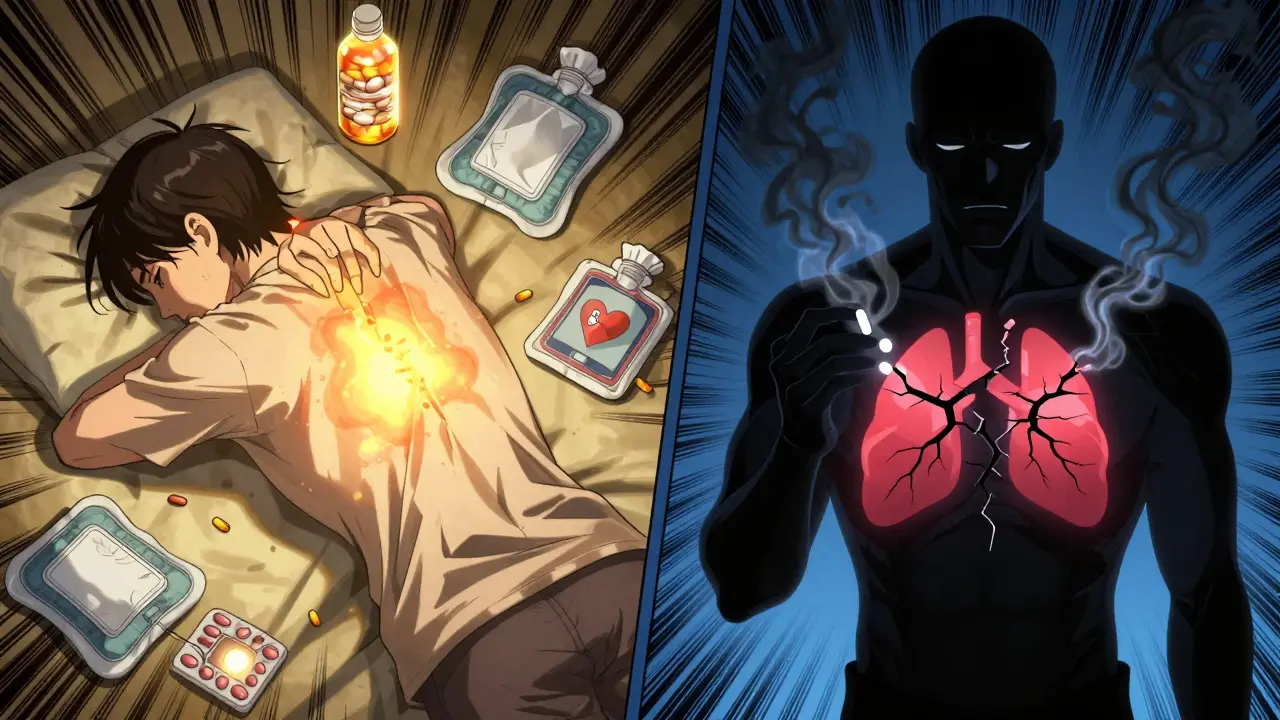
When you hurt - whether it’s a bad back, a knee flare-up, or post-surgery pain - you want relief. Fast. But not all pain meds are created equal. And the safest choice isn’t always the one you’ve been told to reach for first. For years, opioids were the go-to. But the data has changed. So has the advice. Today, the clearest path to real pain relief without putting your life at risk often starts with something completely different.
Why Opioids Aren’t the Answer They Used to Be
Opioids - drugs like oxycodone, hydrocodone, morphine, and fentanyl - work by locking onto receptors in your brain and spinal cord. They block pain signals. They can feel amazing. But they also come with a hidden cost. A 2017 study of nearly 300,000 people found that if you take opioids for more than 180 days over three and a half years, your risk of having a heart attack jumps by 2.66 times. Even if you’re not taking huge doses, just being on opioids long-term raises your odds of a heart attack by 28%. And if you’re taking 120 mg or more of morphine equivalent daily? That risk shoots up another 58%. It’s not just the heart. Opioids slow your breathing. They make you dizzy, nauseous, and constipated. They mess with your sleep. And yes - they can trap you. The CDC reported over 80,000 overdose deaths in the U.S. in 2021 alone. That’s not a statistic. That’s someone’s parent, sibling, or friend. The real kicker? Opioids don’t even work better for long-term pain.What the Science Says About Non-Opioids
In 2018, researchers ran a major trial called SPACE. They took 240 people with chronic back or joint pain and split them into two groups: one got opioids, the other got non-opioid meds like acetaminophen and NSAIDs (think ibuprofen or naproxen). They followed them for a full year. Here’s what they found:- Pain function? No difference.
- Pain intensity? The non-opioid group had less pain.
- Side effects? The opioid group had way more - nausea, dizziness, constipation, and more.
The New Gold Standard: Non-Opioid First
Guidelines have shifted. Hard. In 2022, the CDC released updated rules that say this clearly: "Use nonopioid therapy as the preferred treatment for subacute and chronic pain." The same goes for the American College of Physicians, the California Medical Board, and the VA. They’re not just being cautious. They’re acting on evidence. The SPACE trial became the backbone of this shift. Why? Because it didn’t rely on theory. It watched real people over real time. And the non-opioid group didn’t just survive - they did better. This isn’t about avoiding opioids because they’re "bad." It’s about recognizing that for most people, the risks outweigh the benefits. Especially when safer, effective options exist.
What Are Non-Opioid Options Really Like?
Non-opioid pain relief isn’t one thing. It’s a toolkit:- Acetaminophen (Tylenol): Good for mild to moderate pain. Easy on the stomach. But don’t go over 3,000 mg a day - it can damage your liver.
- NSAIDs (ibuprofen, naproxen): Great for inflammation-based pain - arthritis, sprains, headaches. But they can irritate your stomach and raise blood pressure if used too long.
- Topical treatments: Creams with lidocaine or diclofenac. Applied right where it hurts. Fewer side effects.
- Physical therapy: Often more effective than pills. Strengthens muscles, improves movement, reduces pain long-term.
- Heat, cold, acupuncture, mindfulness: These aren’t "alternative" - they’re evidence-backed tools. Used together, they reduce reliance on meds.
When Might Opioids Still Make Sense?
There are exceptions. Cancer pain. End-of-life care. Severe trauma. Short-term use after major surgery. In these cases, opioids can be lifesaving. But even then, the rule is: use the lowest dose for the shortest time. And always pair them with non-opioid options. A study in Pain Medicine found that patients on sustained-release oxycodone had lower risks of overdose and death than those on morphine. That’s not an excuse to use opioids - it’s a reminder that if you must, choose the safest option.
What Should You Do?
If you’re on opioids for chronic pain and haven’t had a serious talk with your doctor lately - schedule one. Ask: "Is this still the best option for me?" and "What non-opioid alternatives have we tried?" If you’re just starting to treat pain - don’t reach for the prescription pad first. Try acetaminophen. Try ibuprofen. Try heat packs. Try physical therapy. Give them time. Most people find relief without ever needing an opioid. If you’ve been told opioids are your only option - push back. The science doesn’t support that. And you deserve a better, safer path.Final Thought
Pain is real. But so is the risk. The days of "stronger is better" are over. The best pain relief isn’t about intensity - it’s about safety, sustainability, and quality of life. And for most people, that path doesn’t go through an opioid.Are opioids more effective than non-opioids for chronic pain?
No. Multiple high-quality studies, including the landmark SPACE trial, show that non-opioid medications like NSAIDs and acetaminophen are just as effective - if not more so - for long-term pain like back pain or osteoarthritis. Opioids don’t improve function or reduce pain intensity over time, and they come with far greater risks.
Can non-opioid pain relievers cause serious side effects?
Yes, but they’re generally safer than opioids. NSAIDs like ibuprofen can cause stomach bleeding or kidney issues with long-term use. Acetaminophen can damage the liver if taken in excess. But these risks are manageable with proper dosing and monitoring. Opioids, by contrast, carry risks of addiction, overdose, heart damage, and respiratory depression - even at prescribed doses.
Is Journavx available everywhere yet?
Journavx was approved by the FDA in March 2024, but availability depends on insurance coverage and pharmacy stocking. It’s currently approved for acute pain after surgery, not for chronic conditions. It’s not a magic bullet, but it’s an important step toward reducing opioid dependence in acute care settings.
Why do doctors still prescribe opioids if they’re risky?
Historically, opioids were overprescribed due to aggressive marketing and outdated guidelines. Many providers still lack training in non-opioid alternatives. But guidelines have changed. The CDC, VA, and major medical boards now recommend non-opioid first. If your doctor hasn’t discussed safer options, it’s okay to ask why opioids are being suggested over other proven treatments.
What should I do if I’m worried about opioid dependence?
Talk to your doctor about tapering off. Never stop suddenly. Combine the taper with non-opioid pain strategies like physical therapy, heat/cold therapy, or mindfulness. Many clinics now offer pain management programs that help patients transition safely. Support groups and counseling can also help with the psychological side of dependence.

Peter Kovac
March 11, 2026 AT 00:43Pharmaceutical marketing has distorted clinical perception for decades. The opioid crisis was not an accident-it was a predictable outcome of incentivized prescribing.
APRIL HARRINGTON
March 12, 2026 AT 17:27Leon Hallal
March 14, 2026 AT 07:42Judith Manzano
March 14, 2026 AT 21:23Morgan Dodgen
March 16, 2026 AT 20:14Philip Mattawashish
March 17, 2026 AT 04:14Tom Sanders
March 17, 2026 AT 05:43Jazminn Jones
March 18, 2026 AT 04:37Leon Hallal
March 19, 2026 AT 03:42