

Colorectal cancer (CRC) is no longer just a disease of older adults. The landscape has shifted dramatically in recent years, with incidence rates climbing among people under 50. This change forced major health organizations to rewrite the rulebook on prevention and treatment. If you are navigating this diagnosis or preparing for your first screen, understanding the current standards for colonoscopy screening and modern chemotherapy protocols is essential for making informed decisions about your health.
The New Standard: Why Screening Starts at 45
Gone are the days when doctors told you to wait until 50 to get checked. In 2021, the U.S. Preventive Services Task Force (USPSTF) updated its guidelines, lowering the recommended starting age for routine screening from 50 to 45 for adults at average risk. This was not a minor tweak; it was a response to hard data showing a 2.2% annual increase in CRC incidence among adults under 50 between 1995 and 2019. Rectal cancer rates, specifically, have been rising even faster at 3.2% annually in this younger demographic.
This shift aligns with earlier moves by the American Cancer Society, which had already recommended starting at 45 back in 2018. Today, the consensus is clear: if you are between 45 and 75, you should be screened. For those aged 76 to 85, the decision becomes more personal, weighing life expectancy, overall health, and prior screening history against potential benefits. The Centers for Disease Control and Prevention (CDC) now explicitly states that adults in the 45-75 range should undergo regular screening, marking a significant pivot in public health strategy.
Choosing Your Screening Method: Pros and Cons
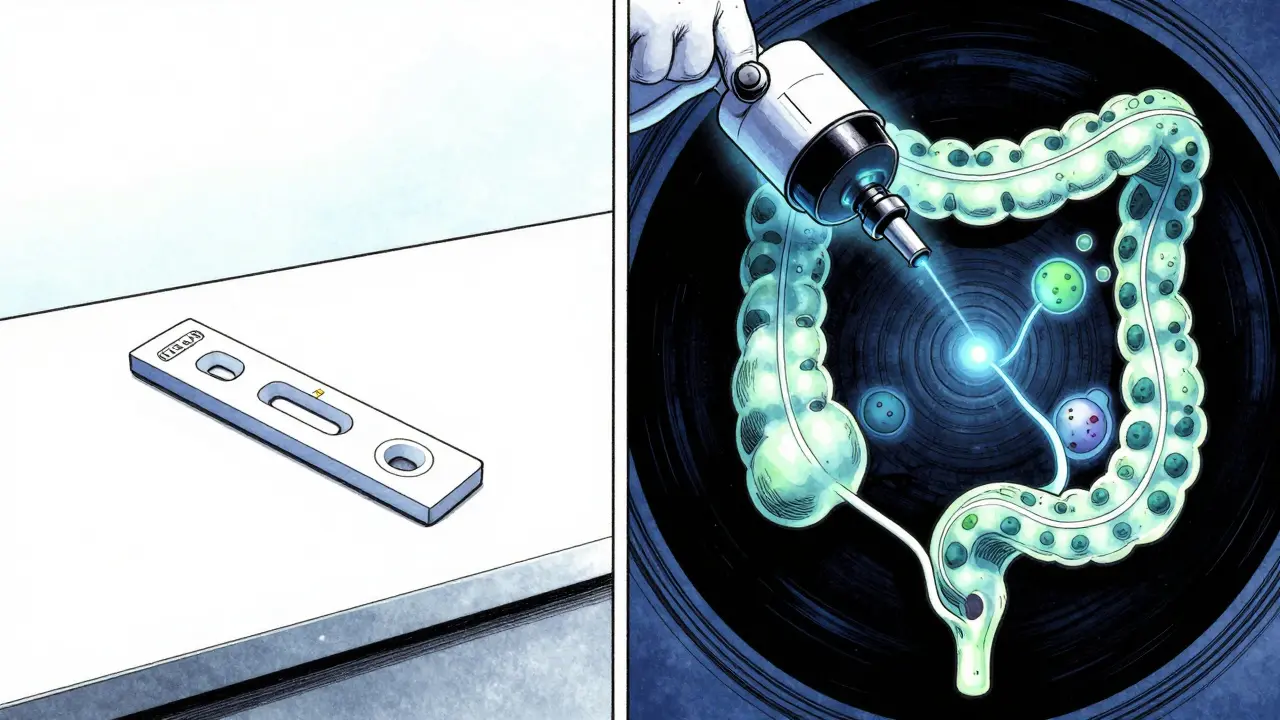
Not all screening tests are created equal. Your choice depends on what you value most: thoroughness, convenience, or speed. Here is how the main options stack up against each other.
| Method | Frequency | Invasiveness | Key Advantage | Key Limitation |
|---|---|---|---|---|
| Colonoscopy | Every 10 years | High (requires sedation) | Detects AND removes polyps | Bowel prep is unpleasant; small perforation risk |
| FIT (Stool Test) | Annually | None | Easy, non-invasive, low cost | Lower sensitivity; requires annual commitment |
| sDNA-FIT (Cologuard) | Every 3 years | None | Higher sensitivity than FIT alone | More false positives leading to unnecessary colonoscopies |
| CT Colonography | Every 5 years | Low (no sedation) | Excellent visualization without drugs | Radiation exposure; cannot remove polyps |
Colonoscopy remains the gold standard for many reasons. It offers a dual benefit: detection and prevention. During the procedure, doctors can remove precancerous polyps immediately, reducing CRC incidence by 67% and mortality by 65%. However, it comes with the dreaded bowel preparation. Patient surveys consistently show that while 89% of people would repeat the procedure due to its effectiveness, 74% describe the prep as "the worst part." The perforation rate is low-about 1 in 1,000 to 1,500 procedures-but it is a real risk.
For those who dread the scope, stool-based tests like the Fecal Immunochemical Test (FIT) offer a viable alternative. FIT has a high sensitivity for CRC detection (79-88%) but must be done every year. Adherence drops significantly over time because it requires ongoing effort. The multi-target stool DNA test (sDNA-FIT), often known by the brand name Cologuard, boosts sensitivity to 92% but sacrifices specificity. This means more false alarms, leading to follow-up colonoscopies that might not have been needed if you had started with the scope.
Who Needs More Than Routine Screening?
If you fall into a high-risk category, the standard guidelines do not apply to you. You likely need to start earlier and screen more frequently. High-risk groups include:
- Family History: Having a first-degree relative (parent, sibling, child) with CRC or advanced adenomas.
- Genetic Syndromes: Conditions like Lynch syndrome or Familial Adenomatous Polyposis (FAP).
- Inflammatory Bowel Disease (IBD): Long-standing Crohn’s disease or ulcerative colitis.
- Personal History: Previous removal of adenomatous polyps or a prior CRC diagnosis.
For these individuals, colonoscopy is almost always the preferred method rather than stool tests. The American College of Gastroenterology emphasizes that African American patients, who face a 20% higher incidence and 40% higher mortality from CRC, should also consider earlier initiation, often starting at 45 regardless of family history.
Chemotherapy Regimens: Treating Advanced Disease
Screening catches cancer early, but for those diagnosed with stage III or IV colorectal cancer, chemotherapy is a cornerstone of treatment. Modern oncology has moved beyond one-size-fits-all approaches. Treatment plans are now highly personalized based on tumor biology, genetic markers, and patient health.
For Stage III CRC (cancer that has spread to nearby lymph nodes), adjuvant chemotherapy is standard after surgery. The goal is to kill any microscopic cells left behind. The most common regimen is FOLFOX, which combines five-fluorouracil (5-FU), leucovorin, and oxaliplatin. An alternative is CAPEOX (also known as XELOX), which uses oral capecitabine instead of intravenous 5-FU. Both regimens typically last for three to six months. Recent studies suggest that for lower-risk Stage III patients, three months of CAPEOX may be as effective as six months, significantly reducing side effects like nerve damage (neuropathy) caused by oxaliplatin.
For Stage IV CRC (metastatic disease), the approach is more complex. Doctors look for specific genetic mutations in the tumor, such as KRAS, NRAS, and BRAF. These mutations determine whether targeted therapies will work alongside chemotherapy.
- Targeted Therapies: Drugs like bevacizumab (Avastin) block blood vessel growth to tumors, while cetuximab (Erbitux) targets EGFR proteins. Cetuximab only works if the tumor is RAS-wild type (meaning it does not have certain mutations).
- Immunotherapy: A small subset of CRC patients (about 5%) have tumors with microsatellite instability-high (MSI-H) or mismatch repair deficiency (dMMR). For these patients, immunotherapy drugs like pembrolizumab (Keytruda) can be remarkably effective, sometimes shrinking tumors where chemo failed.
Side effects vary by drug. Oxaliplatin causes cold-induced neuropathy (tingling or pain in hands/feet when exposed to cold). 5-FU and capecitabine can cause hand-foot syndrome (redness, swelling, peeling of palms and soles) and diarrhea. Managing these symptoms is critical to maintaining quality of life during treatment.
Implementation Challenges and Real-World Barriers
Knowing what to do is different from doing it. Despite clear guidelines, only 67.1% of adults aged 50-75 were up-to-date with screening in 2022. Why the gap? Access and anxiety play huge roles.
Endoscopy capacity is strained. Many safety-net hospitals report wait times exceeding 60 days for a colonoscopy. Dr. David Lieberman, a prominent gastroenterologist, warned that expanding screening to 45-year-olds could delay care for higher-risk patients if capacity isn’t increased. Meanwhile, disparities persist. Uninsured adults have a screening rate of only 58.4%, compared to 78.2% for those with private insurance.
Patient navigation programs help bridge this gap. Studies show that having a dedicated navigator improves completion rates by 35%. Automated reminders also boost adherence by 28%. If you are struggling to get screened, ask your primary care provider about community resources or patient navigators who can help coordinate referrals and explain the process.

Future Directions: Blood Tests and AI
The field is evolving rapidly. Blood-based biomarker tests are on the horizon. The Guardant SHIELD test, for example, showed 83% sensitivity for CRC detection in large trials. While not yet standard for screening, these multi-cancer early detection (MCED) tests promise a future where a simple blood draw could flag CRC alongside other cancers.
Artificial intelligence is also enhancing current tools. AI-assisted colonoscopy systems, like GI Genius, use real-time video analysis to highlight polyps that the human eye might miss. Clinical trials have shown these systems increase adenoma detection rates by 14%, potentially catching more pre-cancerous lesions before they turn malignant.
Next Steps for You
If you are 45 or older, check your records. When was your last screen? If it’s been more than ten years for a colonoscopy, or three years for a stool DNA test, make an appointment today. If you have a family history, talk to your doctor about starting earlier. For those facing a diagnosis, ask your oncologist about genetic testing for your tumor. Knowing your RAS and BRAF status can open doors to targeted treatments that spare you from ineffective chemo cycles. Early detection saves lives, and modern treatments offer hope even in advanced stages.
At what age should I start screening for colorectal cancer?
Most major health organizations, including the USPSTF and CDC, recommend starting routine screening at age 45 for adults at average risk. If you have a family history of colorectal cancer or polyps, inflammatory bowel disease, or a genetic syndrome like Lynch syndrome, you may need to start earlier, possibly in your 20s or 30s. Consult your doctor to determine your personal risk level.
Is colonoscopy the best screening method?
Colonoscopy is considered the gold standard because it can both detect and remove precancerous polyps during the same procedure. It reduces colorectal cancer incidence by 67%. However, it is invasive and requires bowel preparation. Stool-based tests like FIT or sDNA-FIT are valid alternatives for those who prefer non-invasive options, but they require more frequent testing and cannot remove polyps if found.
What are the common chemotherapy regimens for colorectal cancer?
Common regimens include FOLFOX (5-FU, leucovorin, oxaliplatin) and CAPEOX (capecitabine, oxaliplatin) for stage III disease. For stage IV (metastatic) cancer, treatments are tailored based on genetic markers. Options may include targeted therapies like bevacizumab or cetuximab, and immunotherapy for MSI-H/dMMR tumors. The choice depends on the cancer's stage, location, and molecular profile.
How accurate is the Cologuard test?
The multi-target stool DNA test (Cologuard) has a high sensitivity for detecting colorectal cancer (92%), meaning it rarely misses cancer. However, its specificity is lower (87%), leading to more false-positive results compared to FIT. A false positive means you will need to undergo a colonoscopy to rule out cancer, which carries its own risks and costs.
Can lifestyle changes reduce my risk of colorectal cancer?
Yes. Maintaining a healthy weight, exercising regularly, limiting red and processed meats, avoiding smoking, and moderating alcohol intake can lower your risk. Additionally, taking aspirin daily may reduce risk for some people, but you should discuss this with your doctor first due to bleeding risks. Regular screening remains the most effective way to prevent death from colorectal cancer.
What are the side effects of oxaliplatin?
Oxaliplatin, used in FOLFOX and CAPEOX regimens, commonly causes peripheral neuropathy. This manifests as tingling, numbness, or pain in the hands and feet. A unique acute side effect is cold-induced neuropathy, where exposure to cold air or liquids triggers throat tightness or sharp pains. This nerve damage can sometimes be permanent, which is why treatment duration is carefully managed.




Sharon O’Mahonh
May 25, 2026 AT 22:52hey everyone just wanted to drop a quick note that this info is super vital for our collective wellbeing and i really hope we can all support each other in getting screened because prevention is literally the best medicine and lets keep spreading that positive energy around the community
Jonhnnie john13
May 27, 2026 AT 18:01the statistical correlation between delayed screening and mortality rates is undeniable yet the public remains obstinately ignorant of the clinical implications which suggests a systemic failure in health literacy education rather than mere individual negligence
Anthony Padilla
May 29, 2026 AT 09:39i always thought colonoscopy was only for old folks but seeing these numbers for under 50s is wild my cousin got diagnosed at 42 and he had no symptoms at all so yeah definitely gonna book mine soon thanks for sharing this stuff its really eye opening
Elizabeth Fandry
May 29, 2026 AT 15:48one must consider the existential dread inherent in such invasive procedures 🧐 it is truly a testament to human fragility that we subject ourselves to such indignities merely to prolong a biological existence that is ultimately fleeting and meaningless in the grand cosmic scheme of things 😌
Madeline Petes
May 30, 2026 AT 01:33i hate the prep so much but honestly if it saves your life you gotta do it i did mine last year and yes it sucks but knowing im clear is worth every second of drinking that gross stuff dont let fear stop u go get checked!
Ramanath Rao
May 30, 2026 AT 15:11in india we have huge issues with access too but here the problem is people ignoring symptoms until its too late you need to listen to your body not wait for some guideline to tell you when to die this is basic common sense that seems lost on many western patients who treat their doctors like servants
irine sabrina
May 30, 2026 AT 17:53i know how scary this can feel for anyone reading this especially if you have family history please remember that knowledge is power and taking that first step to talk to your doctor is huge you are not alone in this journey and there is so much support available if you just reach out 💖
Gary Helminiak
May 31, 2026 AT 10:25as someone who works in gastroenterology i can tell you that the FOLFOX regimen while effective has some nasty side effects particularly the neuropathy from oxaliplatin which can be permanent so patients really need to understand the tradeoffs before starting treatment and we are seeing more shift towards CAPEOX for lower risk stage iii cases to mitigate those long term nerve damages which is a good development overall 🩺
dane thorp
June 2, 2026 AT 04:26please respect the privacy of others and avoid sharing personal medical details in public forums as this can lead to misinformation and unnecessary panic among readers who may misinterpret anecdotal evidence as clinical fact
Michael Schurmann
June 2, 2026 AT 09:01it is amusing to watch the masses blindly follow these new guidelines without questioning the pharmaceutical interests behind them clearly another attempt to monetize anxiety and expand the market for expensive screening tests that most people do not actually need at this early age
Christina Mitchell
June 3, 2026 AT 10:53the shift in guidelines reflects a deeper understanding of disease progression and societal changes in diet and lifestyle factors we must embrace this scientific evolution with an open mind and recognize that what was true twenty years ago may no longer serve us well today
Christopher Laver
June 5, 2026 AT 06:14boring read
Groman Neta
June 6, 2026 AT 14:35the article fails to adequately address the socioeconomic disparities in healthcare access which renders these guidelines largely theoretical for marginalized populations furthermore the emphasis on high tech solutions ignores the fundamental lack of primary care infrastructure in rural areas
Ryan Jones
June 7, 2026 AT 02:13they want you to believe its just bad luck but look at the chemicals in our food supply and the water fluoridation programs designed to weaken our immune systems over time so you become dependent on their big pharma solutions for everything including cancer which is just a natural detox process they try to suppress
Lisa Russo
June 8, 2026 AT 00:29everyone knows colonoscopy is useless for most people and the stool tests are better but they push the scope because it makes more money for the doctors and hospitals so dont fall for the hype just do the cheap test and save yourself the hassle