

You have a slight feedback whine in your left ear when you’re at the dinner table. In the past, fixing this meant booking an appointment, driving forty-five minutes each way, sitting in a waiting room, and spending twenty minutes with your audiologist. Today, you can likely fix it from your couch while your soup is still hot.
This shift is driven by teleaudiology, which is the delivery of audiology services via telecommunication technologies, enabling remote diagnosis, treatment, and management of hearing conditions without requiring in-person clinic visits. It has moved from a niche emergency workaround during the early 2020s pandemic to a standard pillar of modern hearing healthcare. For millions of people, especially those in rural areas or with mobility issues, this technology isn’t just convenient-it’s the only viable way to access professional care.
How Teleaudiology Actually Works
Teleaudiology isn’t a single tool; it’s a system built on two main methods of interaction: asynchronous and synchronous care. Understanding the difference helps you know what to expect when you log in.
Asynchronous teleaudiology works like email for your ears. You complete a hearing test through a mobile app or web portal at home. The data-your hearing thresholds and preferences-is securely sent to your hearing care professional. They review the results later and send back recommendations or programming changes. There is no real-time conversation. This method is great for routine check-ups or sending over logs of how your devices performed last week.
Synchronous teleaudiology is a live video call. Think of it as a Zoom meeting with your audiologist. During these sessions, providers can see you, hear you speak, and often control your hearing aids remotely. Some advanced setups, like the Clinic-in-a-Box® system used by some clinics, allow the audiologist to trigger specific tones through your headphones while watching your reactions in real time. This mimics the traditional soundproof booth experience but happens over the internet.
| Feature | Asynchronous (Store-and-Forward) | Synchronous (Live Video) |
|---|---|---|
| Interaction Type | No real-time contact | Real-time video/audio |
| Best Used For | Routine monitoring, data review, simple tweaks | New fittings, complex adjustments, counseling |
| Patient Effort | Low (do it on your own time) | Medium (requires scheduled availability) |
| Technical Requirement | Basic internet connection | Stable broadband (min 5 Mbps), webcam, mic |
| Accuracy Limitations | Depends on patient self-reporting accuracy | Can be affected by home ambient noise |
What You Need to Get Started
You don’t need a high-tech lab in your living room, but you do need a few basics. The barrier to entry is lower than most people think, even if you aren’t particularly tech-savvy.
- A Compatible Device: Most modern prescription hearing aids from major manufacturers like Phonak, ReSound, Oticon, and Starkey are Bluetooth-enabled. This connectivity is essential because it allows the audiologist to push software updates and volume changes directly to your device. Older analog models usually cannot be adjusted remotely.
- Smartphone or Computer: You’ll need a device with a camera and microphone. A smartphone is often preferred because many manufacturers have dedicated apps (like myPhonak or ReSound Smart) that streamline the process.
- Stable Internet Connection: A minimum upload/download speed of 5 Mbps is recommended. If your Wi-Fi drops during a live session, the audio quality suffers, making it hard for the audiologist to judge how well you’re hearing speech cues. Using cellular data as a backup is a smart move.
- Wired Headphones: While not always mandatory, using wired headphones connected to your computer or phone significantly reduces background echo and improves the clarity of the test tones during synchronous sessions.
If you are setting up for the first time, expect to spend 20 to 45 minutes downloading apps, creating secure accounts, and pairing your devices. Research indicates that 76% of users become proficient after just one 30-minute tutorial session. The learning curve is gentle, and most providers offer technical support to walk you through the initial setup.
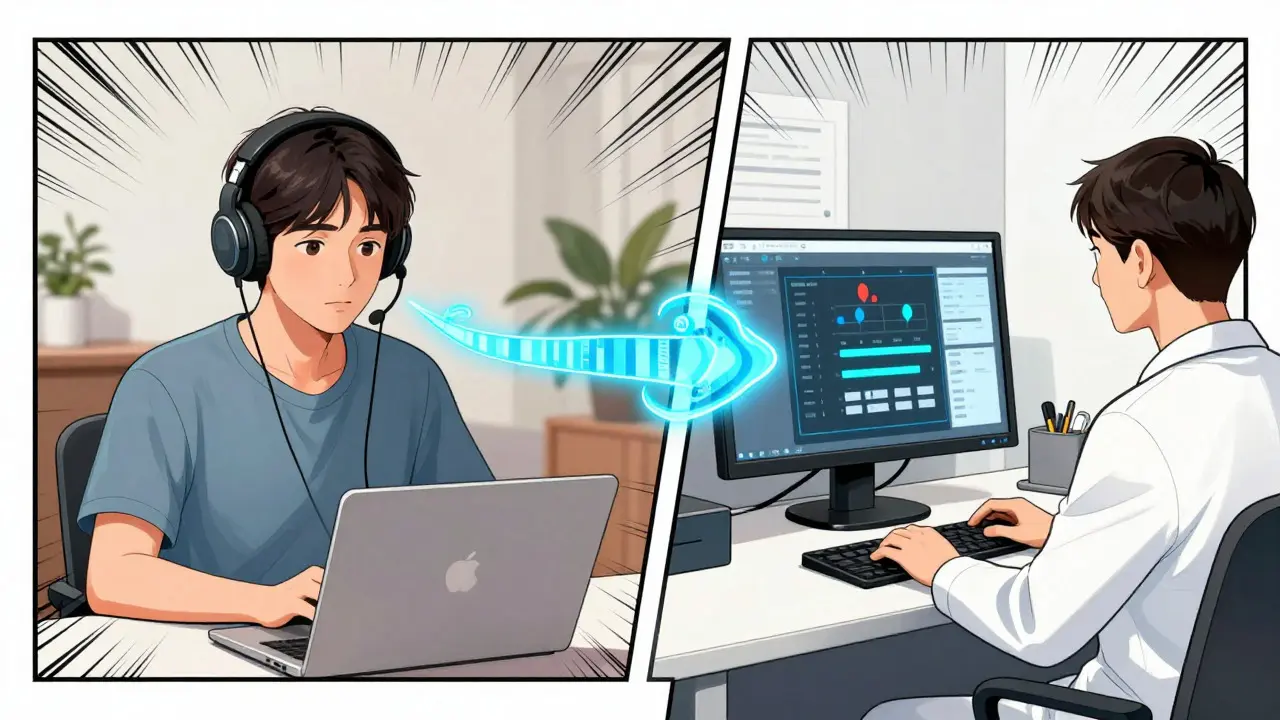
The Real Benefits: Convenience and Access
The primary reason patients switch to remote care is simple: it saves time and money. But the benefits go deeper than just skipping traffic.
Geographical Access: For rural patients, teleaudiology is a lifeline. Studies show that 78% of rural patients previously faced travel distances exceeding 50 miles to reach a clinic. Teleaudiology cuts that travel time from an average of 2.3 hours to near zero. It also reduces associated costs by approximately $87 per appointment when you factor in gas and vehicle wear.
Real-World Adjustments: This is perhaps the biggest clinical advantage. In a clinic, your audiologist adjusts your hearing aids in a quiet, controlled booth. But you don’t live in a booth; you live in a noisy restaurant, a windy park, or a crowded family gathering. With teleaudiology, your provider can adjust your settings while you are actually in those environments. Case studies from Hearzap show this approach improves patient outcomes by 31% for challenging listening situations because the audiologist hears exactly what you hear in real-time.
Cost Efficiency: Teleaudiology visits typically cost 15-20% less than in-person appointments. The average price ranges from $120 to $150 for remote care, compared to $140 to $180 for in-person visits. However, be aware that some premium manufacturer services, such as Phonak’s Remote Support, may carry a monthly subscription fee of around $29.99.
Limitations: When You Still Need to Visit the Clinic
Despite its growth, teleaudiology is not a perfect replacement for all in-person care. It is crucial to understand where the technology falls short so you don’t miss out on necessary medical attention.
No Physical Examination: An audiologist cannot look inside your ear canal via video. This creates a blind spot. Dr. Charles Berlin, a prominent expert in the field, notes that the inability to perform otoscopy remotely creates a 12-15% risk of missing medically significant conditions, such as infections or tumors, that would be spotted during a physical exam.
Cerumen (Earwax) Management: If your hearing suddenly drops, it might not be a device issue-it could be wax buildup. Teleaudiology cannot remove earwax. Many negative user reviews cite frustration when they spent time troubleshooting remotely, only to discover later that a simple in-person cleaning would have solved the problem immediately.
Acoustic Environment Challenges: Home environments are rarely soundproof. Ambient noise from HVAC systems, pets, or neighbors can interfere with remote hearing tests. Data suggests that test accuracy drops from 92-95% in controlled settings to 78-85% in suboptimal home acoustics. About 37% of remote tests are affected by background noise, potentially leading to inaccurate baseline measurements.
Licensure Barriers: Regulations vary by location. As of mid-2024, 28 U.S. states have restrictions on cross-state practice for audiologists. This means you generally need to find a provider licensed in your specific state, which can limit your choice of specialists if you move or travel frequently.
Is It Right for You? Decision Guide
To help you decide whether to book a virtual appointment or drive to the clinic, use this quick guide based on common scenarios.
Choose Teleaudiology If:
- You need a minor adjustment to volume or program settings.
- You are experiencing intermittent feedback or connectivity issues.
- You are traveling or living far from your usual provider.
- You have mobility issues that make travel difficult or painful.
- You want to fine-tune your hearing aids for a specific environment (e.g., a noisy workplace).
Choose In-Person Care If:
- You have sudden hearing loss, pain, or drainage from the ear.
- You suspect an ear infection or excessive wax buildup.
- You are undergoing a comprehensive diagnostic evaluation for the first time.
- Your hearing aids are physically damaged or wet.
- You are uncomfortable with technology or lack reliable internet.
Many experts recommend a hybrid approach. The American Academy of Audiology suggests that while teleaudiology is viable for routine follow-ups, 73% of complex cases still benefit from at least one in-person visit annually to ensure physical health and accurate baselines.
The Future of Remote Hearing Care
The industry is moving fast. We are seeing the integration of Artificial Intelligence into remote care platforms. For example, recent updates from manufacturers like Widex include AI-powered automatic environment detection during remote sessions, which can suggest adjustments before the patient even asks. Signia has also integrated tele-audiology capabilities with Over-the-Counter (OTC) hearing aids, expanding access to millions more consumers who don’t need a prescription.
Regulatory changes are also paving the way. The FDA’s 2024 guidance expanded tele-audiology applications for OTC devices, and Medicare reimbursement rules are slowly adapting, though currently limited to 18 states. Analysts predict that by 2027, tele-audiology will handle 55-60% of all hearing aid follow-up appointments. AI is expected to automate 30-40% of routine adjustments, allowing audiologists to focus on more complex diagnostic cases.
For now, teleaudiology stands as a powerful tool in your hearing health toolkit. It won’t replace the need for occasional physical checks, but for day-to-day management, it offers a level of convenience and responsiveness that was impossible just a few years ago. If you have compatible devices and stable internet, giving it a try for your next minor adjustment could save you hours of hassle and improve your daily listening experience.
Does insurance cover teleaudiology appointments?
Coverage varies significantly by provider and region. As of 2024, Medicare reimburses for tele-audiology services in only 18 U.S. states. Private insurance plans are increasingly covering virtual visits, often at the same rate as in-person appointments, but you should verify your specific plan details before scheduling. Some manufacturer subscription services may be paid out-of-pocket.
Are remote hearing tests as accurate as in-clinic tests?
In controlled home environments, remote hearing tests achieve 92-95% accuracy compared to traditional in-clinic audiometry. However, accuracy can drop to 78-85% if there is significant background noise or poor acoustic conditions. They are highly effective for tracking changes over time and adjusting existing devices, but initial comprehensive diagnostics are often best done in person to establish a precise baseline.
Can an audiologist remove earwax remotely?
No. Teleaudiology relies on video and audio communication, so the provider cannot physically access your ear canal. If you suspect earwax blockage, indicated by muffled hearing or fullness, you will need an in-person visit for irrigation or manual removal. Attempting to adjust hearing aids remotely when wax is present often leads to frustrating results.
What if I’m not good with technology?
Don’t worry. Research shows that 82% of users aged 65 and older successfully navigate teleaudiology systems after minimal guidance. Most providers offer a brief tutorial session to help you download apps and pair your devices. Additionally, many platforms offer customer support lines where technicians can talk you through any connectivity issues step-by-step.
Do I need special equipment for teleaudiology?
You need a smartphone or computer with a camera and microphone, and a stable internet connection (at least 5 Mbps). Your hearing aids must be Bluetooth-enabled and compatible with remote programming, which applies to most modern prescription models from major brands. Wired headphones are recommended for computer-based sessions to reduce echo and improve test accuracy.