

Ever looked at your prescription bottle and wondered why some meds have strict refill rules while others don't? Or maybe you've noticed a "Schedule" code on a medication guide and felt like you needed a law degree to understand it. You aren't alone. The system used to track medications with a high potential for misuse can feel like a puzzle, but it's actually a highly structured safety net designed to keep dangerous drugs from falling into the wrong hands.
At its core, this system is managed by the Controlled Substances Act is a federal U.S. drug policy established in 1970 that classifies medications based on their medical utility and potential for abuse. By creating a "closed system," the government can track a drug from the moment it's manufactured to the second it's dispensed at your local pharmacy. If you're trying to understand why your doctor can't just "call in" a refill for certain painkillers, the answer lies in these schedule codes.
The Five Schedules: What the Numbers Actually Mean
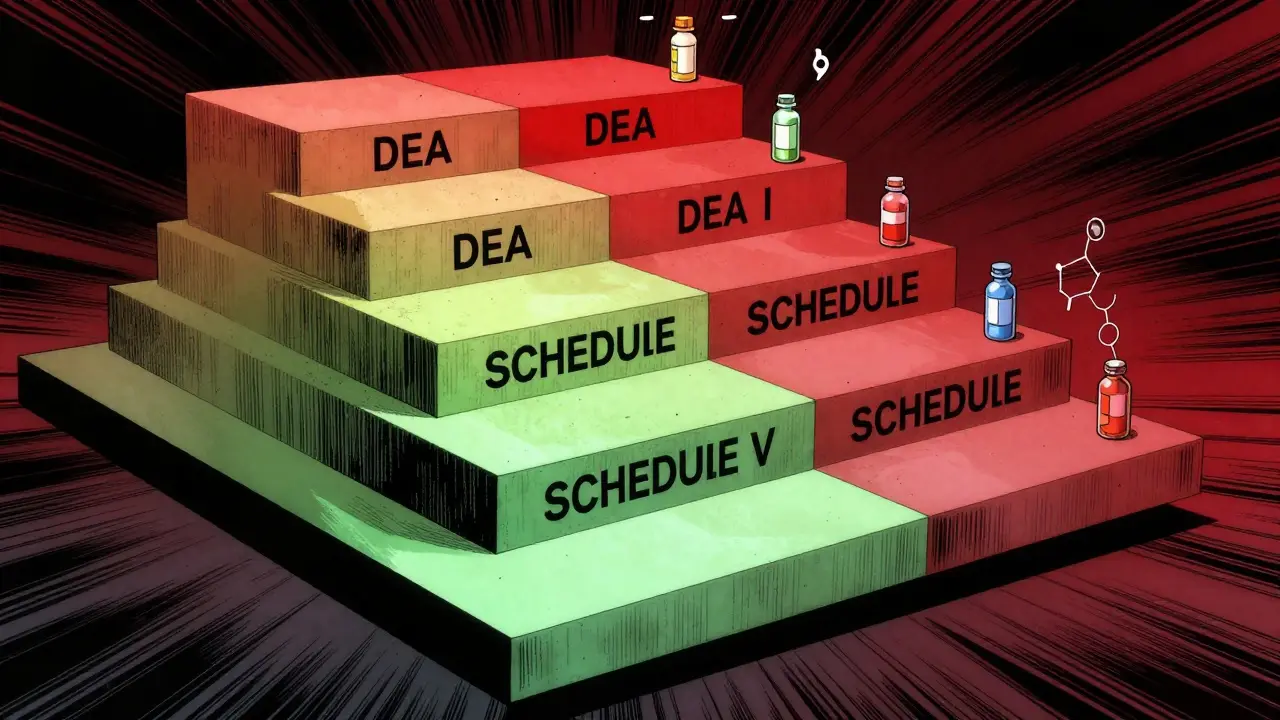
Not all controlled substances are created equal. The Drug Enforcement Administration (DEA) puts drugs into five categories, or "schedules," based on how likely they are to cause dependence and whether they have a recognized medical use. Here is the breakdown of how these schedules work in the real world.
Schedule I is the most restrictive. These are drugs with no currently accepted medical use and a high potential for abuse. Think of substances like heroin or LSD. Because they're in Schedule I, they cannot be legally prescribed by a doctor. There is a famous point of contention here with cannabis; despite many states legalizing it for medical use, it remains federally listed as Schedule I, creating a complex legal tug-of-war.
Schedule II includes drugs that have high abuse potential but are definitely useful for treating pain or severe symptoms. Examples include Oxycodone and fentanyl. Because these are high-risk, the rules are tight: no refills are allowed. You need a brand new prescription every single time.
Schedule III medications have a moderate to low potential for abuse. A common example is a combination drug like Tylenol with a small amount of codeine. These are more flexible than Schedule II; you can usually get up to five refills within a six-month window.
Schedule IV drugs have a low potential for abuse. You'll find medications like Xanax (alprazolam) or Ambien here. Like Schedule III, these allow for limited refills, making them easier for patients to manage for long-term anxiety or sleep issues.
Schedule V is the lowest tier. These drugs have the lowest risk of dependence. Some cough medicines with tiny amounts of codeine fall into this group. In some states, these are so low-risk that you can even get them over-the-counter with a pharmacist's supervision.
| Schedule | Abuse Potential | Medical Use | Refill Rules | Example Drugs |
|---|---|---|---|---|
| I | Highest | None | No Prescriptions | Heroin, LSD |
| II | High | Yes | No Refills | Morphine, Fentanyl |
| III | Moderate | Yes | Max 5 (6 months) | Ketamine, Steroids |
| IV | Low | Yes | Max 5 (6 months) | Valium, Xanax |
| V | Lowest | Yes | Varies/OTC | Pregabalin |
Why Your Pharmacy Process Takes Longer for Some Meds
If you've ever felt like the pharmacy is taking forever with a specific prescription, it might be because of the regulatory paperwork involved. For Schedule II drugs, the documentation is grueling. In most states, these must be written on tamper-resistant paper to prevent fraud. Some oncology nurses have noted that processing a single Schedule II prescription can take up to 15 minutes longer than a standard med because of these strict handling requirements.
Pharmacists also have to deal with the Controlled Substance Code Number (CSCN), which is a unique identifier assigned by the DEA. You might see abbreviations on your paperwork like "NARC" (for Narcotic) or "CSA SCH" (for CSA Schedule). This isn't just for the pharmacist; it's for the federal auditors who ensure that no pills are "going missing" from the supply chain.
To make things slightly faster, the DEA introduced the Controlled Substance Ordering System (CSOS). Before this electronic system, ordering Schedule II meds took days. Now, pharmacies can get their shipments in under 24 hours, which means you're less likely to face a "we're out of stock" situation at the counter.
The Impact of Concentration: How One Drug Can Have Multiple Codes
One of the most confusing parts of this system is that the same drug can appear in different schedules depending on how it's mixed. This is where the controlled substance labels get tricky. Take codeine as an example:
- Pure Codeine: Because it's potent and concentrated, it's a Schedule II drug.
- Codeine mixed with Acetaminophen: When combined in certain doses, it drops to Schedule III.
- Codeine in cough syrup: If the concentration is very low (less than 200mg per 100ml), it can be Schedule V.
This is why you might notice your medication rules change if you switch from a pill to a liquid version of the same drug. The DEA isn't just looking at the ingredient; they're looking at the total dose and how easy it would be for someone to abuse the formulation.
How Doctors Manage the Paperwork
Your doctor doesn't just wake up and start writing these prescriptions. To prescribe any controlled substance, a healthcare provider must have a DEA registration number. This is a specific ID (usually two letters followed by six or seven digits) that ties the doctor to a specific practice location. Getting this number takes weeks of processing, and doctors have to spend hours in residency training just to learn the legal pitfalls of the system.
If a doctor makes a mistake on a Schedule II script-like forgetting a signature or a date-the pharmacy cannot simply "call the doctor to fix it." In many cases, the entire prescription is void, and a new one must be issued. This is why your doctor might be extra cautious (or slow) when handling these specific medications.

Is the Scheduling System Still Effective?
While the system provides a necessary structure for tracking dangerous drugs, it's not without its critics. Many healthcare providers argue that the rules create unnecessary barriers to patient care. In some pharmacy circles, there's a feeling that the strictness of Schedule II is too rigid for patients with chronic, legitimate pain who have to travel long distances to see their doctor every month just for a new piece of paper.
There is also a growing movement to modernize these classifications. For instance, the Department of Health and Human Services recently recommended moving cannabis from Schedule I to Schedule III. This would be a historic shift, acknowledging that the drug has medical value and a lower risk profile than heroin. Many experts believe we are moving toward a more nuanced risk-benefit framework, potentially adding more categories to better distinguish between different levels of risk.
Can I get a refill on a Schedule II medication?
No. Federal law prohibits refills on Schedule II prescriptions. Your doctor must issue a brand new prescription for every single fill. Some states allow electronic prescriptions, but the requirement for a new order every time remains.
What happens if I lose my Schedule II prescription?
Because these are high-security documents, you cannot simply ask the pharmacy to "duplicate" it. You will need to contact your doctor's office, and they will likely have to verify the loss before issuing a replacement, which may take several days.
Why is my medication Schedule IV instead of Schedule II?
This depends on the drug's chemical makeup and how it affects the brain. Schedule IV drugs have a lower potential for physical or psychological dependence than Schedule II drugs, meaning they are considered safer for use over longer periods with fewer restrictions.
Does the DEA monitor my use of these medications?
The DEA monitors the system (manufacturers, wholesalers, and pharmacies) rather than individual patients. However, many states have their own Prescription Monitoring Programs (PMPs) that track when and where you fill controlled substances to prevent "doctor shopping."
Are all Schedule V drugs available without a prescription?
Not all of them. While some Schedule V drugs can be bought over-the-counter with pharmacist approval, many still require a prescription. It depends on the specific drug and the laws of the state you are in.
Next Steps for Patients
If you are taking a medication with a schedule code, the best thing you can do is stay organized. For those on Schedule II meds, set a reminder to contact your doctor a week before your medication runs out, since you can't just hit a "refill" button on your pharmacy app. If you're confused about your medication's classification, ask your pharmacist to show you the DEA code on the label-they can explain exactly why certain restrictions are in place for your specific dose.


Thomas Jorquez
April 29, 2026 AT 11:49This is a pretty solid breakdown of how the system works, though the bureaucracy is still a total nightmare for anyone actually tryin to get medz.
Angela Cook
May 1, 2026 AT 08:17Our US laws are the gold standard for a reason! Keeping these dangerous drugs under tight federal control is the only way to protect the American family from the chaos of addiction. Anyone complaining about a bit of paperwork is just lazy and doesn't appreciate the security our government provides!
Ryan Wilson
May 2, 2026 AT 21:20The absolute audacity of some people to moan about a few minutes of pharmacy wait time when the alternative is a total pharmacological wasteland of pill-pushers and junkies. It's a clusterfuck of a system, sure, but the rigidness is the only thing stopping the entire population from turning into a bunch of chemical zombies. This whole 'barrier to care' argument is just a thinly veiled excuse for people who want their narcotics delivered via drone while they binge-watch trash TV.
Jonathan Hall
May 3, 2026 AT 01:38It's just incredibly frustrating when you consider how these regulations, while theoretically designed for safety, end up punishing the most vulnerable people who are just trying to manage chronic pain and find a shred of peace in their daily lives. I've seen people drive three hours just to get a piece of paper because the system is so archaic that a simple digital signature isn't enough for some outdated federal guideline, and it honestly feels like we're prioritizing red tape over actual human suffering in a way that is just completely unacceptable in a modern society.
Raymond Lipanog
May 3, 2026 AT 02:54The tension between administrative rigor and individual accessibility is a profound ethical dilemma. One must consider if the preservation of social order through the Controlled Substances Act outweighs the momentary inconvenience of the patient.
lalit adesara
May 4, 2026 AT 17:16Western laws are mere shells. True healing comes from discipline, not chemicals.
Abhishek Charan
May 6, 2026 AT 07:07Actually... the DEA is just playing a game of pretend!!! 🤡 Why is cannabis still Schedule I when the data is clearly outdated??? It's an absolute joke... 🙄🤣 Total incompetence!!!
Darrin Oneto
May 8, 2026 AT 02:30Yeah, that cannabis thing is a real trip. Totally bonkers that the feds are still sleepin on it while every state is just vibin with the change. Just a total mess, man.
Jean Robert
May 9, 2026 AT 00:17I really feel for everyone who is struggling to navigate this complex system, and I want you to know that you aren't alone in feeling overwhelmed by all these rules. It can be so taxing to manage your health while also fighting with insurance and pharmacy regulations, but if you just take it one step at a time and keep your reminders set, you can definitely get through the hurdles. Please remember to be kind to yourself and your pharmacists, as they're often just as stressed by the paperwork as we are, and we're all just trying to get the care we need to feel better and live a healthier life together.