
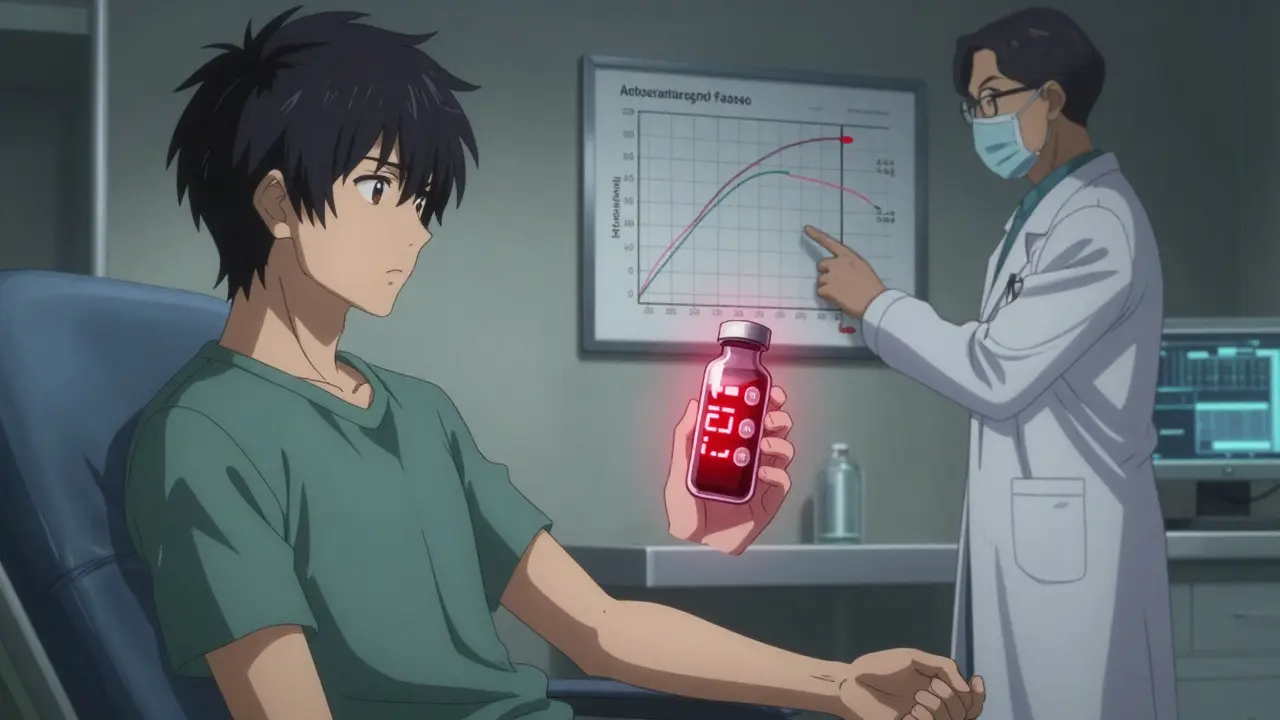
When patients switch from brand-name HIV medications to generic versions, many assume the treatment works the same way. But with certain drugs, especially those used in HIV therapy, that assumption can be dangerous. Therapeutic drug monitoring (TDM) isn’t a routine test-it’s a lifeline for people on generic antiretrovirals where small differences in absorption or metabolism can mean the difference between viral suppression and treatment failure.
Why Generic Drugs Aren’t Always Interchangeable
Generic antiretroviral drugs are required to be bioequivalent to their brand-name counterparts. That means they should deliver the same amount of drug into the bloodstream over time. But bioequivalence doesn’t guarantee identical effects in every patient. Some people absorb drugs poorly due to gastrointestinal issues, liver damage, or even food interactions. Others metabolize drugs too quickly because of genetic differences or other medications they’re taking. When you’re on a drug with a narrow therapeutic index-like protease inhibitors or NNRTIs-these small variations matter.Take lopinavir/ritonavir, a common protease inhibitor. Studies show that patients on generic versions can have up to 40% lower plasma concentrations than those on the brand-name drug. That’s not just a number-it’s a risk. If drug levels fall below the minimum inhibitory concentration, the virus can replicate, develop resistance, and make future treatment options limited or ineffective. TDM measures exactly how much drug is in the blood, so doctors can adjust doses before resistance takes hold.
What TDM Actually Measures (and What It Doesn’t)
Therapeutic drug monitoring tracks the concentration of a drug in the blood, usually the lowest level just before the next dose (called the trough or Cmin). For drugs like dolutegravir or efavirenz, staying above a certain threshold keeps the virus suppressed. If levels are too low, the dose goes up. If they’re too high, the risk of side effects like liver damage or neurological issues increases.But TDM doesn’t work for all HIV drugs. Nucleoside reverse transcriptase inhibitors (NRTIs)-like tenofovir, emtricitabine, and abacavir-don’t respond to TDM. Why? Because they’re prodrugs. They don’t act in the bloodstream. Instead, they need to enter cells and get converted into their active form inside the cell. You can’t measure what’s happening inside a cell just by looking at blood levels. That’s why TDM is only useful for drugs that circulate in plasma and act directly there-mainly protease inhibitors and non-nucleoside reverse transcriptase inhibitors (NNRTIs).
When TDM Makes the Biggest Difference
TDM isn’t for everyone. But it’s critical in specific situations:- Patients switching to generic versions of protease inhibitors or NNRTIs
- People with kidney or liver disease that affects drug processing
- Those taking other medications that interfere with HIV drugs-like rifampin for tuberculosis or certain anticonvulsants
- Children and adolescents, where standard dosing based on weight often misses the mark
- Patients with persistent diarrhea, vomiting, or malabsorption
A 2022 study from South Africa showed that in a group of patients on generic antiretrovirals, those who received TDM-guided dosing had a 22% lower rate of treatment failure than those who didn’t. In one case, a patient on generic lopinavir/ritonavir had undetectable viral loads for months-then suddenly spiked. TDM revealed drug levels were half of what they should be. The dose was doubled, and within six weeks, the virus was suppressed again.

The Real Barriers to Using TDM
Despite its value, TDM isn’t widely used. Why?- Cost: In the UK NHS, a single test runs £250-£350. In the U.S., private labs charge $450-$650. Insurance rarely covers it unless there’s a clear clinical reason.
- Turnaround time: Public labs often take 10-14 days to return results. By then, a patient may have already developed resistance or severe side effects.
- Access: Only a handful of specialized centers in the U.S. and Europe offer TDM for HIV drugs. Most clinics don’t have the equipment or trained staff.
- Guidelines: The U.S. Department of Health and Human Services doesn’t recommend routine TDM. The European AIDS Clinical Society only supports it for specific cases.
Some clinicians avoid TDM because they’re not trained to interpret the results. A low drug level doesn’t always mean the patient isn’t taking the pill. It could be a drug interaction, poor absorption, or even a lab error. Without experience, misinterpreting TDM data can lead to unnecessary dose changes-or worse, no change when one is needed.
How TDM Fits Into Real-World Care
TDM doesn’t replace viral load testing. It complements it. Viral load tells you if the virus is under control. TDM tells you why it might not be.Imagine two patients with the same viral load rebound. One has poor adherence. The other takes every pill on time. For the second patient, TDM can uncover hidden problems: a new supplement that blocks drug absorption, a change in liver enzymes, or a generic drug that’s not being metabolized properly. In these cases, TDM guides precise fixes-no guesswork.
One NHS clinic reported that after implementing TDM for patients on generic protease inhibitors, they reduced treatment failures by 18% over 18 months. They didn’t change protocols. They didn’t add new drugs. They just started measuring drug levels in high-risk patients.

What’s Next for TDM?
The future of TDM isn’t about making it routine. It’s about making it smarter.- Faster testing: Some private labs now offer 2-3 day turnaround for urgent cases. As demand grows, public systems may follow.
- Targeted use: Instead of testing everyone, guidelines are shifting to focus on high-risk groups-like those on TB co-treatment, pregnant women, or patients with drug interactions.
- Integration with resistance testing: When TDM shows low drug levels and resistance testing shows mutations, the picture becomes clear: the patient was exposed to suboptimal drug levels long enough for resistance to develop. This combo helps prevent future failures.
- Global access: In low-income countries, TDM is being piloted to ensure generic drugs actually work. In South Africa and Thailand, pilot programs are showing promising results in reducing resistance rates.
The bottom line: Generic drugs save money. But they don’t always save lives if they’re not absorbed properly. TDM isn’t perfect. It’s expensive, slow, and not universally available. But for patients on critical antiretrovirals-especially when switching to generics-it’s one of the few tools that can catch problems before they become irreversible.
What Patients Should Know
If you’re on a generic HIV medication and you’ve had trouble with side effects, missed doses, or a rising viral load, ask your provider: "Could TDM help explain what’s happening?" Don’t assume it’s not an option. Many clinics don’t offer it because they don’t know how to access it-not because it’s not useful.Also, don’t confuse TDM with viral load testing. One checks if the virus is under control. The other checks if the drug is doing its job. Both are needed.
Is therapeutic drug monitoring used for all HIV drugs?
No. TDM is only useful for drugs that act in the bloodstream, like protease inhibitors (e.g., lopinavir, darunavir) and non-nucleoside reverse transcriptase inhibitors (e.g., efavirenz, rilpivirine). It does not work for NRTIs (e.g., tenofovir, emtricitabine) because they must be activated inside cells, not in the blood.
Why is TDM important for generic drugs?
Generic drugs are required to be bioequivalent, but small differences in manufacturing or absorption can lead to lower drug levels in some patients. For drugs with a narrow therapeutic index, even a 20% drop in concentration can cause treatment failure or drug resistance. TDM catches these differences before they cause harm.
How long does it take to get TDM results?
In public health systems, results typically take 10-14 days. Private labs can return results in 2-3 days for urgent cases, but they cost $450-$650 per test. Delays are one of the biggest challenges-by the time results come back, a patient may already have developed resistance.
Can TDM prevent drug resistance?
Yes, indirectly. By identifying low drug levels early-before viral load rises-TDM allows clinicians to adjust doses or switch regimens before the virus has time to mutate. Studies show that in high-risk patients, TDM can reduce resistance development by up to 30% compared to standard care.
Is TDM covered by insurance?
In most cases, no. Insurance typically only covers TDM when there’s a documented clinical reason-like drug interactions, organ dysfunction, or treatment failure despite good adherence. Routine use is rarely approved.
Where is TDM available?
TDM for HIV drugs is only available in specialized centers. In the U.S., fewer than 10 labs offer it. In the UK, only 3-5 centers provide it through the NHS. In Canada, McGill University Health Centre offers it routinely. Outside these centers, access is extremely limited.
Can TDM replace viral load testing?
No. Viral load testing tells you if the virus is under control. TDM tells you if the drug is reaching the right level in your blood. They work together. A patient can have undetectable viral load but still have suboptimal drug levels-meaning they’re at risk if adherence slips. TDM adds a layer of safety.
Therapeutic drug monitoring isn’t magic. It’s not a cure. But for patients on generic antiretrovirals-especially those with complex health needs-it’s a critical safety net. When used right, it doesn’t just monitor drug levels. It protects lives.



Richard Harris
March 13, 2026 AT 19:15ps. sorry for the typos, typing on my phone with one hand while holding coffee
Kandace Bennett
March 15, 2026 AT 07:51Tim Schulz
March 15, 2026 AT 15:36Next thing you know, we’ll be TDM-ing aspirin. 'Oh no, Mr. Smith, your plasma concentration of acetylsalicylic acid is 0.8 ng/mL below threshold. You’re one sneeze away from a heart attack.'
Jinesh Jain
March 16, 2026 AT 03:49douglas martinez
March 17, 2026 AT 04:11Shruti Chaturvedi
March 17, 2026 AT 20:40Katherine Rodriguez
March 19, 2026 AT 14:20Devin Ersoy
March 21, 2026 AT 13:58Scott Smith
March 23, 2026 AT 10:49Sally Lloyd
March 24, 2026 AT 11:00