

You’ve been diagnosed with rheumatoid arthritis (RA), and now you’re sitting in a rheumatologist’s office. The doctor is counting your joints, asking how you feel, and maybe ordering blood tests or scans. It can feel like a maze of numbers and acronyms. But here’s the truth: these aren’t just random checks. They are precise tools designed to track whether your treatment is actually working.
Monitoring RA isn’t about guessing. It’s about data. We use specific scores like CDAI (Clinical Disease Activity Index) and DAS28 (Disease Activity Score 28), combined with imaging techniques like ultrasound and MRI, to see what’s happening inside your joints. The goal? To hit a target-usually remission or low disease activity-and stay there. This approach, known as "treat-to-target," has been proven to reduce joint damage by up to 50% compared to routine care. Let’s break down exactly how these tools work, why they matter, and what you should expect at your next visit.
Understanding the Clinical Disease Activity Index (CDAI)
The CDAI (Clinical Disease Activity Index) is often the first tool a rheumatologist will reach for during a routine check-up. Why? Because it’s fast, simple, and doesn’t require waiting for lab results. Developed by the American College of Rheumatology (ACR) and published in 2005, the CDAI calculates your disease activity based on four straightforward components:
- Tender Joint Count (TJC): How many of 28 specific joints hurt when touched?
- Swollen Joint Count (SJC): How many of those same 28 joints are visibly swollen?
- Patient Global Assessment (PtGA): On a scale of 0 to 10, how active do you feel your arthritis is right now?
- Physician Global Assessment (PGA): On a scale of 0 to 10, how active does your doctor think your arthritis is?
You simply add these four numbers together. The result ranges from 0 to 76. Here is how to interpret that number:
- Remission: Score less than 2.8
- Low Disease Activity: Score between 2.8 and 10
- Moderate Disease Activity: Score between 10 and 22
- High Disease Activity: Score greater than 22
The beauty of the CDAI is its immediacy. In a 2023 study involving nearly 4,000 patients, the CDAI showed the strongest correlation (0.84) with a physician’s clinical impression. Since it doesn’t rely on blood tests, you get an answer right then and there. If your score is high, your doctor can adjust your medication plan immediately. However, because it ignores inflammatory markers in your blood, it might miss subtle inflammation that isn’t causing obvious pain or swelling yet.
Decoding the DAS28 Score
If the CDAI is the quick snapshot, the DAS28 (Disease Activity Score 28) is the detailed report card. Originating in Europe in the 1990s through research by the European League Against Rheumatism (EULAR), the DAS28 includes everything in the CDAI but adds one crucial layer: objective measures of inflammation from your blood.
There are two main versions of this score:
- DAS28-ESR: Uses the Erythrocyte Sedimentation Rate (ESR), a test that measures how quickly red blood cells settle in a tube. Higher settling speeds indicate more inflammation.
- DAS28-CRP: Uses C-Reactive Protein (CRP), another marker of inflammation that reacts faster to changes in the body.
The formula for DAS28 is complex-it involves square roots and natural logarithms-but the interpretation remains similar to the CDAI:
- Remission: Score less than 2.6
- Low Disease Activity: Score between 2.6 and 3.2
- Moderate Disease Activity: Score between 3.2 and 5.1
- High Disease Activity: Score greater than 5.1
So, which one is better? Experts like Dr. Michael D. George note that while DAS28 provides a more complete picture of inflammatory burden, it creates workflow challenges. Lab results often arrive after you’ve already left the clinic. In fact, a 2022 registry analysis found that in 68% of cases, doctors had to make provisional decisions without the final CRP or ESR values. For many patients, especially those who want immediate feedback, the CDAI feels more practical. But if your doctor suspects hidden inflammation despite low pain levels, the DAS28 is invaluable.

The Role of Imaging in RA Monitoring
Scores tell us how you feel and what the blood says, but imaging shows us what’s actually happening to your bones and tissues. For decades, conventional X-rays were the gold standard. While still useful for tracking long-term structural damage using the Sharp/van der Heijde scoring system, X-rays have a major blind spot: they only show damage after it has occurred. You might need six to twelve months of active disease before an erosion appears on an X-ray.
This is where advanced imaging steps in.
Ultrasound: The Practical Detective
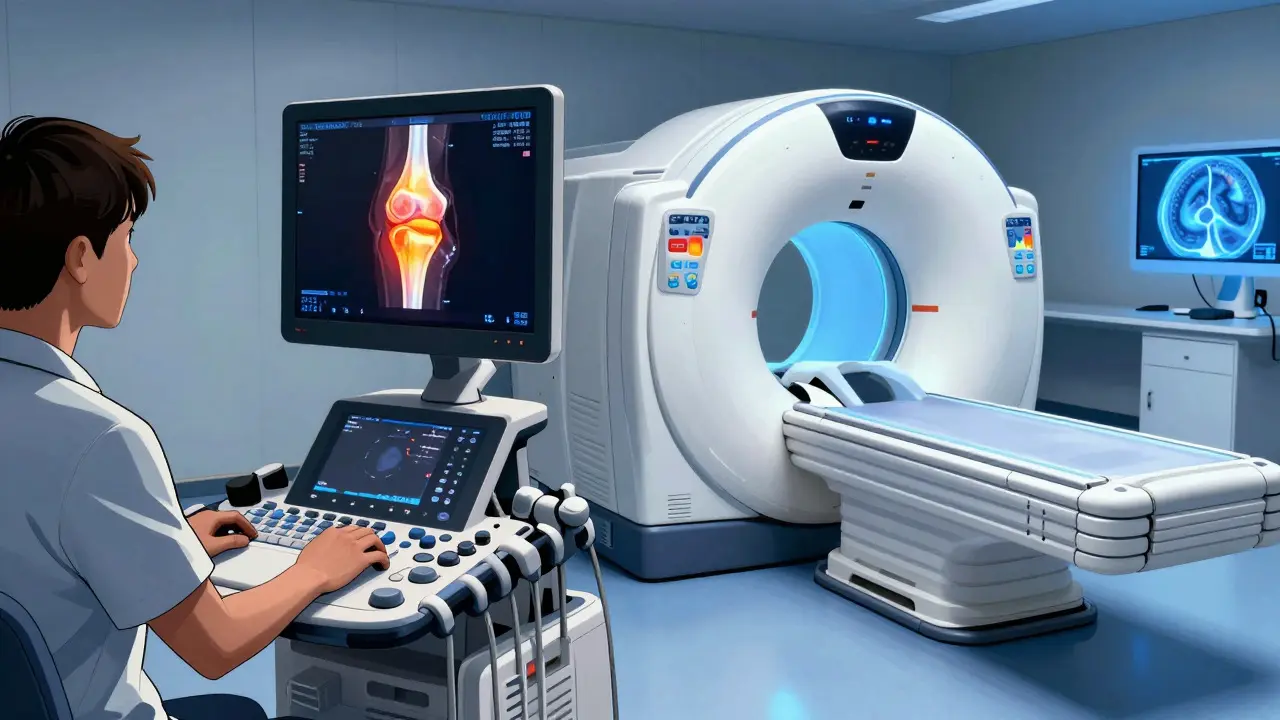
Musculoskeletal Ultrasound has become a game-changer in RA monitoring. Unlike X-rays, ultrasound can detect synovitis (inflammation of the joint lining) and power Doppler signals (increased blood flow due to inflammation) long before bone damage occurs. Studies show ultrasound has an 85% sensitivity for detecting synovitis, compared to just 65% for physical examination alone.
Why do we love it? It’s relatively inexpensive (around $150 per scan in the US), widely available, and provides real-time visual feedback. During your appointment, you can watch the screen and see exactly which joints are inflamed. A 2022 EULAR working group noted that integrating ultrasound into routine monitoring changes treatment decisions in 22% of cases where a physical exam alone would have led to maintaining current therapy.
MRI: The High-Resolution Lens
Magnetic Resonance Imaging (MRI) is the most sensitive tool we have. It can detect bone edema (also called osteitis), which is essentially early bone inflammation that precedes erosions. Research indicates that MRI can predict future bone erosions with 89% sensitivity. It uses the RAMRIS scoring system to evaluate synovitis, bone edema, and erosions across 28 joints.
However, MRI comes with trade-offs. It’s expensive (approximately $1,200 per scan in the US), time-consuming, and not always covered by insurance for routine monitoring. Because of this, it’s typically reserved for specialized centers, clinical trials, or cases where the diagnosis is unclear. As Dr. Mikkel Østergaard, a leading expert in RA imaging, points out, MRI’s cost and limited availability restrict its routine use, making it less practical for everyday patient care compared to ultrasound.
| Tool | Key Components | Pros | Cons | Best For |
|---|---|---|---|---|
| CDAI | Joint counts, Patient & Physician assessments | No labs needed; instant results | Misses subclinical inflammation | Routine visits; quick adjustments |
| DAS28 | Joint counts, Assessments, ESR or CRP | Includes objective inflammation markers | Requires blood tests; delayed results | Confirming remission; research |
| Ultrasound | Synovitis, Power Doppler | Real-time visuals; detects early inflammation | Operator dependent; moderate cost | Clinical uncertainty; targeted monitoring |
| MRI | Synovitis, Bone Edema, Erosions | Highest sensitivity; predicts damage | High cost; limited access | Complex cases; clinical trials |
Putting It All Together: The Treat-to-Target Strategy
None of these tools exist in a vacuum. They are part of a broader strategy called "treat-to-target." This means your doctor and you agree on a specific goal-usually remission (CDAI < 2.8 or DAS28 < 2.6) or low disease activity-and monitor you regularly until you hit it.
Here is how this looks in practice:
- Baseline Assessment: At diagnosis, your doctor establishes your starting CDAI/DAS28 score and may order baseline imaging (X-rays or ultrasound) to check for existing damage.
- Frequent Monitoring: When starting or changing medication, you’ll be seen every 1-3 months. Your doctor will calculate your CDAI or DAS28 each time.
- Adjustment: If your score hasn’t improved significantly (the Minimal Important Difference for CDAI is 4.0 units), your doctor will adjust your treatment. This might mean increasing the dose of your current drug or switching to a different class of medication, such as biologics or JAK inhibitors.
- Imaging Integration: If your clinical scores suggest remission but you still have pain, or if scores are ambiguous, your doctor might order an ultrasound to look for hidden inflammation. Conversely, if scores are high but you feel fine, they might check for other causes of pain.
- Maintenance: Once you reach your target, monitoring becomes less frequent (every 3-6 months), focusing on maintaining stability and preventing flare-ups.
This systematic approach reduces the guesswork. Instead of waiting for a painful flare to signal that something is wrong, you catch the problem early. Data from the GO-BACK study shows that this method reduces radiographic progression by 30-50% compared to routine care. That’s a massive difference in preserving your joint function over time.
Common Challenges and What Patients Can Do
Even with these sophisticated tools, monitoring isn’t perfect. One common issue is discordance between what you feel and what your doctor sees. In a Brazilian cohort study, 33% of patients had mismatched global assessments, with most patients rating their symptoms higher than their physicians did. This can lead to frustration if you feel your concerns aren’t being heard.
To make the most of your monitoring:
- Be Honest About Symptoms: When asked to rate your pain or activity on a 0-10 scale, don’t hold back. Your subjective experience is a critical part of the CDAI and DAS28 calculations.
- Ask About Imaging: If you have persistent pain despite good scores, ask if an ultrasound might help clarify the situation. It’s a reasonable request, especially if your doctor is uncertain about your treatment plan.
- Understand Your Scores: Don’t just accept a number. Ask your doctor what it means. Is it improving? Are we close to remission? Understanding the trajectory helps you stay engaged in your care.
- Track Trends: Single scores can fluctuate. Look at the trend over several visits. Consistent improvement is a good sign, even if you haven’t hit remission yet.
Remember, these tools are meant to empower you, not overwhelm you. By understanding how CDAI, DAS28, and imaging work together, you can have more productive conversations with your healthcare team and take an active role in protecting your joints.
What is the difference between CDAI and DAS28?
The main difference is that CDAI relies solely on clinical assessments (joint counts and patient/doctor ratings), while DAS28 incorporates blood test results (ESR or CRP) to measure systemic inflammation. CDAI is faster and doesn't require labs, making it ideal for routine visits. DAS28 provides a more comprehensive view of inflammatory burden but depends on timely lab results.
How often should I have my RA monitored?
Frequency depends on your disease activity. When starting or changing treatment, you should be monitored every 1-3 months. Once you achieve remission or low disease activity, monitoring typically shifts to every 3-6 months. Imaging like ultrasound or MRI is usually done annually or when clinical uncertainty arises.
Can ultrasound replace X-rays for RA monitoring?
Not entirely. Ultrasound is better at detecting early inflammation (synovitis) and guiding immediate treatment decisions. X-rays remain the gold standard for assessing long-term structural damage (erosions and joint space narrowing). Many doctors use both: ultrasound for active management and X-rays for annual baseline checks of bone health.
What does it mean if my CDAI score is in remission but I still have pain?
This is a common scenario. Remission based on CDAI means inflammatory activity is very low. Persistent pain could be due to non-inflammatory causes like muscle strain, fibromyalgia, or established joint damage. In these cases, your doctor might order an ultrasound to rule out hidden synovitis or consider other sources of pain.
Is MRI necessary for everyone with rheumatoid arthritis?
No, MRI is not necessary for everyone. Due to its high cost and limited availability, it is typically reserved for complex cases, diagnostic uncertainty, or participation in clinical trials. For most patients, clinical scores (CDAI/DAS28) and ultrasound provide sufficient information to guide effective treatment.