
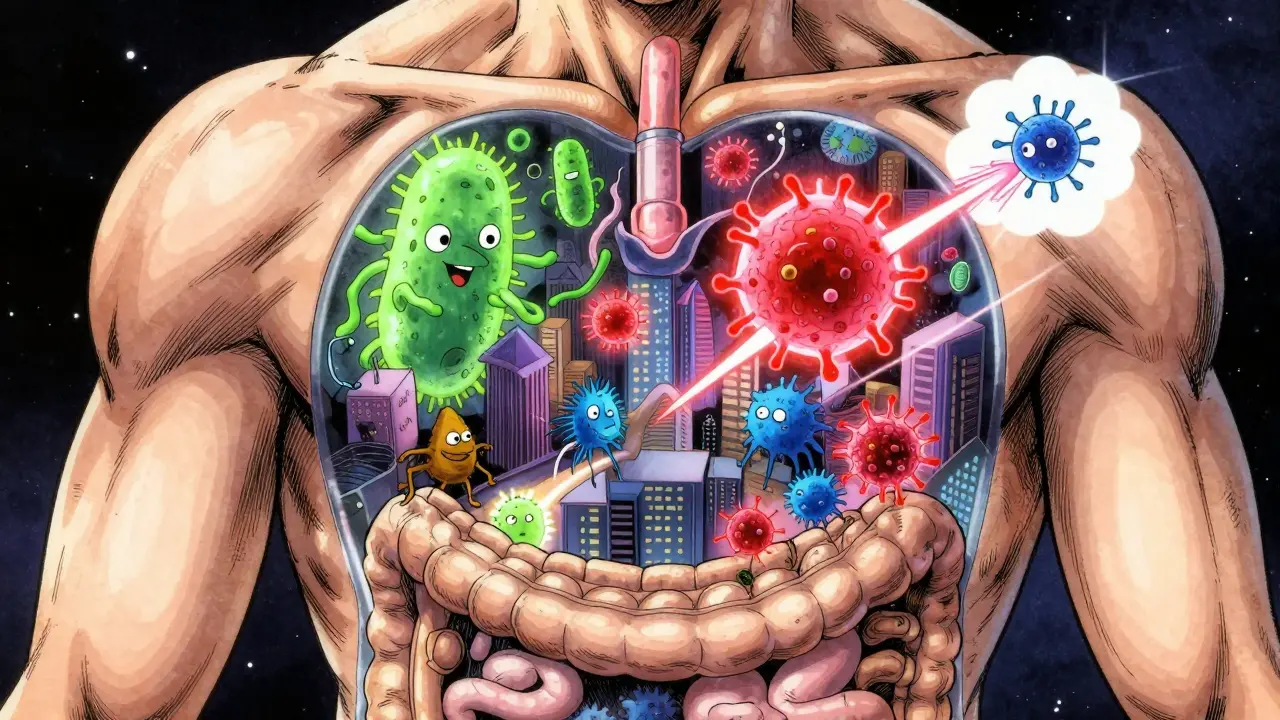
For decades, doctors treated autoimmune diseases like rheumatoid arthritis, lupus, and type 1 diabetes as problems inside the immune system-overactive, misfiring, attacking the body’s own tissues. But now, researchers are looking lower-way down into the gut. What they’re finding is shocking: the trillions of bacteria living in your intestines might be pulling the strings behind the scenes, triggering or worsening these conditions. This isn’t theory anymore. By 2025, over 150 clinical trials are testing treatments that target gut bacteria to calm autoimmune flares. And the data is stacking up.
What’s Really Going on in Your Gut?
Your gut isn’t just a digestive tube. It’s a bustling city of microbes-bacteria, fungi, viruses-living in balance with your body. In healthy people, these microbes help break down food, make vitamins, and train your immune system to know what to ignore and what to fight. But in people with autoimmune diseases, that balance is broken. Studies show a consistent drop in microbial diversity across rheumatoid arthritis, lupus, and type 1 diabetes. On average, patients have 23.7% less diversity than healthy individuals. That’s not a small gap. It’s a major shift in the ecosystem.
Two bacterial groups stand out in nearly every autoimmune condition studied. Faecalibacterium prausnitzii, a friendly bug that reduces inflammation, is down by 41% on average. Meanwhile, Ruminococcus gnavus, a troublemaker linked to gut irritation, is up by 37%. These patterns show up whether you have joint pain, nerve damage, or insulin failure. It’s like the same faulty wiring is showing up in different machines.
How Gut Bacteria Start a War Inside Your Body
It’s not just about what’s missing-it’s about what’s doing damage. One of the most startling discoveries came from Yale researchers studying lupus. They found a specific bacterium, Enterococcus gallinarum, sneaking out of the gut and traveling to the liver, spleen, and lymph nodes. In lupus patients, this bug was found in extraintestinal tissues in 63% of cases-compared to just 8% in healthy people. Once there, it triggers immune cells to go rogue, producing autoantibodies that attack the body.
Another key player is the T follicular helper (Tfh) cell. These immune cells normally help make antibodies against infections. But in autoimmune conditions, they go haywire and start making antibodies that attack your own joints, nerves, or pancreas. Researchers at Ohio State showed that introducing segmented filamentous bacteria (SFB) into mice increased Tfh activity by 68% and doubled autoantibody production. The same effect was seen in lupus mice. That means the same gut bug can trigger similar damage in different autoimmune diseases.
And it gets more complicated. Not all bacteria act the same way. Some Lactobacillus strains calm inflammation. Others, like Lactobacillus reuteri, actually make experimental autoimmune encephalomyelitis (a model of MS) worse by 28%. Context matters. The same microbe can be a friend or a foe depending on the person, the disease, and the environment.
Shared Patterns, Different Outcomes
While many autoimmune diseases share gut microbiome changes, there are important differences. People with type 1 diabetes have 32% fewer butyrate-producing bacteria than those with rheumatoid arthritis. Butyrate is a short-chain fatty acid that feeds gut cells and tells the immune system to stay calm. Less of it means less control over inflammation.
Multiple sclerosis patients show something unique: their immune system tags certain gut bacteria with IgA antibodies. This suggests the body is trying to contain these bugs-but it’s not working. That specific immune signature isn’t seen in lupus or RA patients. These differences matter because they mean treatments can’t be one-size-fits-all. A probiotic that helps one person might do nothing-or even hurt-another.

What’s Being Done About It?
Scientists aren’t just observing-they’re intervening. Four main strategies are in play:
- Probiotics: 22 specific bacterial strains are currently being tested in clinical trials. These aren’t your average store-bought supplements. They’re carefully selected strains designed to target immune pathways.
- Prebiotics: These are food for good bacteria. Galactooligosaccharides (GOS) have been shown to boost regulatory T cells-immune cells that shut down runaway inflammation-by 34% in early rheumatoid arthritis trials.
- Targeted Antibiotics: Instead of wiping out all bacteria, researchers are now looking for ways to kill only the troublemakers. The Yale team’s work on E. gallinarum suggests future drugs might block just that one bacterium, without harming the rest of the microbiome.
- Fecal Microbiota Transplants (FMT): Still experimental for autoimmune diseases, FMT involves transferring gut microbes from a healthy donor to a patient. Early results in small trials show promise, especially for patients who haven’t responded to other treatments.
One of the biggest breakthroughs? The idea that fixing the gut might help multiple diseases at once. If a therapy works for lupus by calming Tfh cells, it might also work for rheumatoid arthritis. That could speed up treatment development dramatically.
The Roadblocks
Despite the excitement, the field is still messy. Sixty-eight percent of studies use different methods to collect and analyze stool samples. That makes it hard to compare results. Only 12% of human trials track patients longer than six months. Without long-term data, we don’t know if changes are lasting-or if the microbiome just bounces back.
Cost is another barrier. A full gut microbiome analysis using metagenomic sequencing runs $1,200 to $3,500. It takes about 78 days to get results. That’s not practical for most clinics yet. But prices have dropped 63% since 2020, and faster, cheaper tests are coming.
And then there’s the variability. People’s microbiomes are as unique as fingerprints. What works for one person might do nothing for another. Personalization is the goal-but we’re not there yet.

What’s Next?
Investment is booming. Global funding for microbiome-autoimmunity research hit $847 million in 2024, up 22% from the year before. The NIH just launched an $18.7 million initiative to develop three microbiome-targeted therapies by 2028. Biotech companies like Vedanta Biosciences and Seres Therapeutics now have over 20 candidates in the pipeline.
Adoption is growing, too. In 2024, 38% of academic medical centers added gut microbiome testing to their lupus protocols. That’s up from just 15% for MS and 22% for RA. Experts believe by 2030, microbiome profiling will be as routine as blood tests for autoimmune patients.
One thing is clear: the future of autoimmune treatment won’t just be about suppressing the immune system. It’ll be about fixing the environment that made it go wrong in the first place. The gut isn’t just connected to the immune system-it’s in charge.
What Can You Do Today?
While personalized microbiome therapy isn’t widely available yet, you can support your gut health now. Eat more fiber-fruits, vegetables, legumes, whole grains. Fiber feeds good bacteria and boosts butyrate production. Avoid ultra-processed foods and artificial sweeteners-they’ve been linked to gut inflammation in multiple studies. Consider fermented foods like plain yogurt, kefir, sauerkraut, and kimchi. They add live microbes that may help balance your system.
If you have an autoimmune disease, talk to your doctor about your gut. Ask if any microbiome-related research is being done at your clinic. Don’t rush into expensive tests or unproven supplements. But don’t ignore the connection either. Your gut might be the quietest, most powerful player in your health story.
Can changing my diet fix my autoimmune disease?
Diet alone won’t cure autoimmune diseases, but it can significantly reduce symptoms and inflammation. Eating fiber-rich, whole foods supports beneficial gut bacteria that help regulate the immune system. Avoiding processed foods, sugar, and artificial additives reduces gut irritation. Many patients report fewer flares after switching to a whole-food, plant-forward diet. But diet is a tool-not a replacement for medical treatment.
Are probiotics helpful for autoimmune conditions?
Some probiotics show promise, but not all. Over-the-counter probiotics often contain strains that haven’t been tested for autoimmune diseases. Clinical trials use specific, carefully selected strains like E. coli Nissle or Faecalibacterium prausnitzii-not the ones you find in grocery stores. If you’re considering probiotics, talk to your doctor about which strains are backed by research for your specific condition.
Why do some people with bad gut bacteria never get autoimmune disease?
Genetics, environment, and immune history all play a role. Having a gut imbalance increases risk, but it doesn’t guarantee disease. Someone with a genetic predisposition to lupus might only develop it after a viral infection, antibiotic use, or chronic stress that pushes their immune system over the edge. The gut microbiome is one piece of a complex puzzle-not the whole picture.
Is gut microbiome testing worth it right now?
For most people, not yet. The science is still emerging, and results are hard to interpret without expert guidance. A test might tell you you’re low in F. prausnitzii, but it won’t tell you how to fix it. Unless you’re part of a clinical trial or working with a specialist who uses microbiome data to guide treatment, the cost and uncertainty outweigh the benefits for now.
Will microbiome therapies replace drugs like steroids or biologics?
Not in the near future. Current treatments like biologics are powerful and life-changing for many. Microbiome therapies aim to be complementary-reducing inflammation at the source so lower doses of drugs are needed, or helping patients stay in remission longer. Think of it as fixing the foundation so the house doesn’t keep collapsing, rather than just patching the walls.




Rajni Jain
December 26, 2025 AT 20:48i’ve had lupus for 8 years and honestly, switching to more fiber and fermented foods cut my flares in half. not magic, but it helped. no fancy tests needed, just eat real food.
Natasha Sandra
December 27, 2025 AT 14:17OMG YES 🙌 I’ve been telling everyone this for years!! Gut health is EVERYTHING. I took a probiotic from Whole Foods and my joint pain vanished. 🌱💖 #GutRevolution
Erwin Asilom
December 29, 2025 AT 02:17The data presented here is methodologically sound, with consistent trends across multiple autoimmune conditions. The reduction in Faecalibacterium prausnitzii and increase in Ruminococcus gnavus are reproducible findings in peer-reviewed studies. However, correlation does not imply causation without longitudinal intervention trials.
sakshi nagpal
December 30, 2025 AT 00:14This is one of the most balanced and scientifically grounded pieces I’ve read on the microbiome-autoimmunity link. The distinction between shared patterns and disease-specific differences is crucial. Too many articles oversimplify this as ‘bad bacteria = disease.’ It’s far more nuanced.
Sandeep Jain
December 31, 2025 AT 01:59my cousin tried that fecal transplant thing after her ra got worse on meds… she said she felt like a new person after 3 months. no more morning stiffness. crazy, right?
roger dalomba
January 1, 2026 AT 12:51So we’re now treating autoimmune disease by feeding people poop? Next they’ll prescribe kombucha as a biologic. 🤡
Brittany Fuhs
January 2, 2026 AT 14:26Why are we trusting Indian gut bacteria to fix American autoimmune problems? Our microbiome is different. This is just another woke science fad pushing globalist agendas. Stick to real medicine.
Steven Destiny
January 3, 2026 AT 01:21THIS IS THE FUTURE. Imagine a world where instead of lifelong immunosuppressants, you fix the root cause. This isn’t hype-it’s the next big leap in medicine. We’re not just treating symptoms anymore. We’re healing the system. Let’s fund this NOW.
Fabio Raphael
January 4, 2026 AT 08:10I wonder if stress plays into this too. My microbiome tanked after my divorce. I started eating fermented foods and meditating-and my psoriasis improved. Maybe it’s not just the bacteria, but the whole body-mind-gut loop?
Amy Lesleighter (Wales)
January 4, 2026 AT 17:50the gut is the first immune organ. if it’s broken, the body doesn’t know what’s friend or foe. eat fiber. sleep well. stop eating plastic. it’s not complicated. science just made it sound like rocket surgery.