
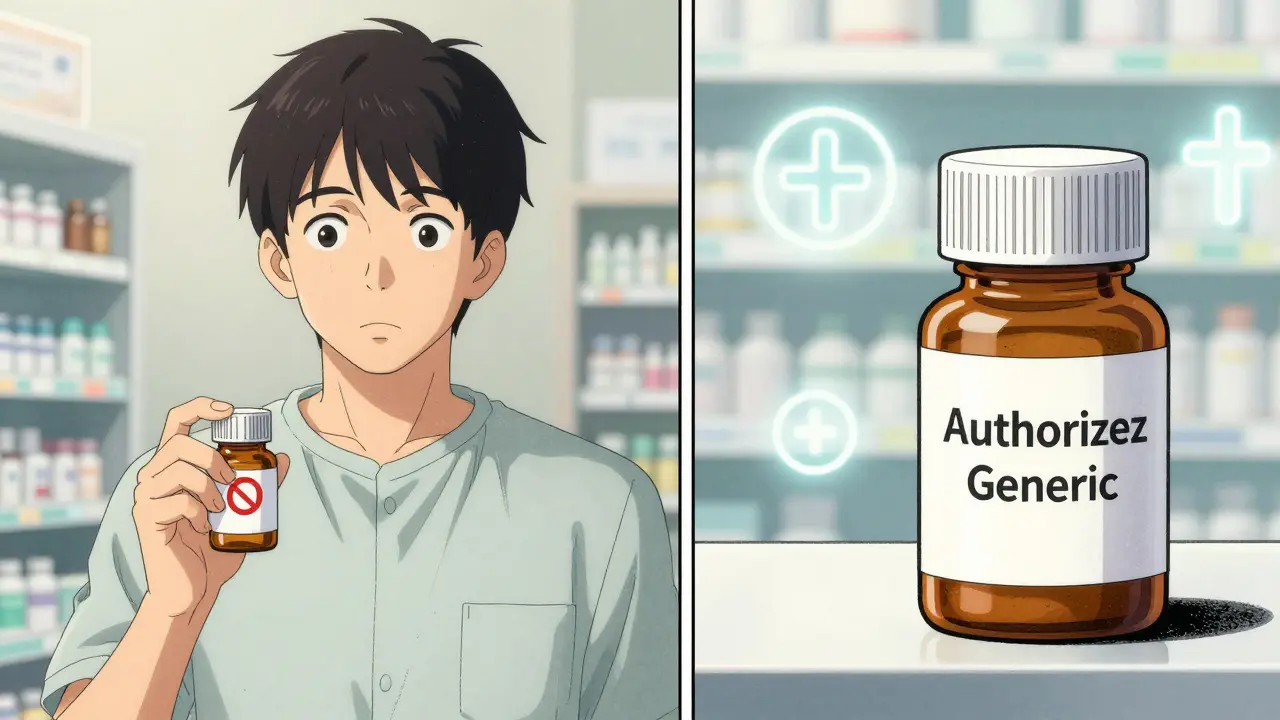
When a brand-name drug loses its patent, it’s not just a legal shift-it’s a financial earthquake. Suddenly, cheaper generics flood the market, and sales plummet. But here’s something most people don’t know: many of those cheap generics aren’t made by some new startup. They’re made by the same company that made the brand-name drug in the first place. These are called authorized generics.
What exactly is an authorized generic?
An authorized generic is the exact same pill, capsule, or injection as the brand-name drug. Same active ingredient. Same inactive ingredients-like fillers, dyes, and coatings. Same manufacturing process. The only difference? No brand name on the label. It’s the same product, just sold under a different name, often at a lower price.For example, if you’ve taken Concerta for ADHD, you might have seen a generic version labeled as methylphenidate ER. But if that generic was made by Janssen (the maker of Concerta), it’s an authorized generic. Same drug. Same bottle. Just no brand logo.
Unlike traditional generics, which have to prove they work the same way through expensive bioequivalence tests, authorized generics skip all that. They’re approved under the original brand’s New Drug Application (NDA). That means the FDA doesn’t need to review them again. All the manufacturer has to do is notify the agency they’re selling it under a different label. This makes launching an authorized generic faster and cheaper than launching a traditional generic.
Why do brand companies do this?
It’s not charity. It’s strategy.When a patent expires, the first company to file for a generic version gets 180 days of exclusive rights to sell that generic-no competition. That’s called the Hatch-Waxman exclusivity period. During those six months, that first generic can charge high prices and dominate the market. That’s great for the generic maker, but terrible for the brand company.
So here’s what brand companies do: they launch their own authorized generic right before or during that 180-day window. Suddenly, the first generic isn’t alone anymore. Now there are two versions of the same drug on the shelf. One is the generic from the startup. The other is the brand’s own version, sold cheaper. That forces the first generic to lower its price too-or risk losing sales.
According to a 2022 study in Health Affairs, between 2010 and 2019, there were 854 authorized generic launches in the U.S. About 70% of them came out during or just before that critical 180-day window. That’s not coincidence. That’s a calculated move.
Do authorized generics help consumers?
Yes-and no.The Federal Trade Commission found in 2011 that when authorized generics enter the market during the exclusivity period, prices drop 15-20% faster than in markets without them. That means patients pay less sooner. For people on long-term medications like blood pressure pills or thyroid medicine, that adds up.
There’s another benefit: consistency. Some drugs have a narrow therapeutic index-meaning even tiny differences in ingredients can affect how they work. Think of drugs like warfarin, levothyroxine, or seizure medications. Traditional generics might use different fillers or coatings. That’s usually fine. But for some patients, those small changes cause side effects or make the drug less effective. Authorized generics solve that. Since they’re identical to the brand, patients who struggled with traditional generics often do better on the authorized version.
Pharmacists have seen it firsthand. One Reddit user, u/MedCheck2020, wrote: “I’ve had patients stabilized on brand who failed on traditional generic but did fine on authorized generic due to identical inactive ingredients.” That’s not anecdotal-it’s clinical.
But what’s the catch?
Critics say authorized generics are a loophole. The Generic Pharmaceutical Association (GPhA) argues they delay real competition. If the brand company launches its own generic, it takes the spotlight off independent generic makers. That means fewer companies enter the market later, which could keep prices higher over time.Dr. Jerry Avorn from Harvard put it bluntly in a 2019 JAMA commentary: “Authorized generics represent a sophisticated market manipulation strategy that ultimately benefits brand manufacturers more than consumers in the long term.”
And he’s not wrong. Brand companies get to keep control. They decide when to launch. They set the price. They can even pull the authorized generic off the market once the exclusivity period ends and traditional generics take over. That’s not competition-it’s market management.
And then there’s confusion.
Patients don’t understand the difference between an authorized generic and a traditional generic. A 2023 Drugs.com review for an authorized generic of Singulair said: “I got this ‘generic’ but it looks identical to the brand I used before-is this actually generic?” The answer? Yes, it is. But most people don’t know that.
A 2021 survey found that 57% of independent pharmacies reported a spike in patient questions about authorized generics after the FDA required clearer labeling. Pharmacy staff say they spend extra time explaining that “this isn’t a knockoff-it’s the same thing, just cheaper.”
How does this affect pharmacies and insurers?
It’s messy.Authorized generics aren’t listed in the FDA’s Orange Book-the official directory of approved drugs and their therapeutic equivalents. That means pharmacists can’t rely on the Orange Book to confirm if a drug is interchangeable. They have to know the manufacturer, check the label, or look it up in their system.
Many pharmacy software systems didn’t even have a category for authorized generics until recently. Epic Systems added one in 2021, which cut identification errors by 67%. But smaller pharmacies still struggle. About 41% reported billing issues because insurance systems don’t always recognize authorized generics as distinct from brand or traditional generics.
On the payer side, pharmacy benefit managers (PBMs) like Express Scripts and OptumRx love them. They’ve found that patients trust authorized generics more than traditional ones. In 2021, Express Scripts reported 28% higher usage of authorized generics compared to traditional generics in their formularies. Why? Because they’re seen as higher quality.
Which drugs are most likely to have authorized generics?
It’s not random. Certain drug classes are far more likely to get them.Central nervous system drugs-like ADHD meds, antidepressants, and seizure drugs-lead the pack. Why? Because even small changes in inactive ingredients can affect how the brain responds. A 2022 analysis showed 67% of CNS drugs with patent expirations got authorized generics.
On the other end? Antibiotics. Only 22% of those had authorized generics. Why? Because the body doesn’t care as much about fillers in a 7-day course of amoxicillin. If a patient gets a traditional generic and it works, no one notices.
Other high-usage categories include cholesterol meds (like statins), diabetes drugs, and hormone replacements. These are drugs people take for years. Consistency matters. That’s why companies like Pfizer (through Greenstone Pharmaceuticals) and Teva have built entire divisions around authorized generics.
What’s next for authorized generics?
The trend is growing. In 2022, 38 of the top 50 branded drugs facing patent expiration had authorized generics within 12 months. Evaluate Pharma predicts that by 2027, 45% of major branded drugs will have them-up from 32% in 2022.The FDA’s list of authorized generics has grown to 1,247 products as of October 2025. That’s more than double the number from a decade ago.
But pressure is building. In 2023, Congress introduced the “Promoting Competition in Pharmaceutical Markets Act,” which would ban brand companies from launching authorized generics during the 180-day exclusivity window. If it passes, it could change the whole game.
Some analysts think we’re nearing saturation. Bernstein Research believes the strategy will lose its punch after 2027 as more generic makers enter the market. Others, like Jefferies Financial Group, expect growth through 2030 as brands look for every way to protect revenue.
One thing’s clear: authorized generics aren’t going away. They’re here to stay. And whether you see them as a win for patients or a clever trick by big pharma, they’re changing how we think about generics.
What should you do as a patient?
If you’re on a brand-name drug and it’s about to go generic, ask your pharmacist: “Is there an authorized generic?”It’s often cheaper than the brand. It’s often cheaper than the traditional generic. And if you’ve had issues with other generics before, it might be the only one that works for you.
Don’t assume all generics are the same. Some are. Some aren’t. Authorized generics are the closest thing to the brand you can get-without paying the brand price.
And if you see a pill that looks exactly like your brand but has a different name? Don’t panic. It might be better than you think.
Are authorized generics the same as brand-name drugs?
Yes. Authorized generics contain the exact same active and inactive ingredients as the brand-name drug. They’re made in the same factory, using the same process. The only difference is the label. They’re not copies-they’re the same product sold under a different name.
Why aren’t authorized generics listed in the FDA’s Orange Book?
Because they’re marketed under the brand’s original New Drug Application (NDA), not a separate Abbreviated New Drug Application (ANDA). The Orange Book only lists drugs approved under ANDAs. Authorized generics bypass that process entirely, so they don’t appear there-even though the FDA confirms they’re therapeutically equivalent.
Do authorized generics cost less than traditional generics?
Sometimes, but not always. Authorized generics often cost less than the brand-name version and sometimes less than traditional generics, especially during the first 180 days after patent expiration. But prices vary by pharmacy, insurer, and region. Always compare prices at your pharmacy or use tools like GoodRx to find the best deal.
Can I switch from a brand to an authorized generic safely?
Yes. Since authorized generics are chemically identical to the brand, switching is safe for nearly all patients. This is especially important for drugs with a narrow therapeutic index, like levothyroxine or warfarin, where even small changes in formulation can affect how the drug works. Many patients who had issues with traditional generics do better on authorized generics.
Why do some patients think authorized generics are just the brand in disguise?
Because they often look identical. Authorized generics may have the same color, shape, and markings as the brand-just without the brand name. This can confuse patients who expect generics to look different. Pharmacists sometimes have to explain that this isn’t a trick-it’s the same drug, just sold under a different label to offer a lower price.
Stephen Tulloch
January 16, 2026 AT 14:40Bro. Authorized generics are the *only* reason I’m not bankrupt. Took Concerta for 8 years. Switched to the Janssen generic and my brain didn’t melt. Traditional generics? I’d feel like a zombie on a treadmill. 😅
Joie Cregin
January 17, 2026 AT 22:19OMG I had no idea this was a thing. My mom’s on levothyroxine and she kept switching between generics and getting headaches. We just found out her pharmacy was giving her the authorized one all along-she didn’t even know. She’s been smiling like a kid on Christmas since. 🌈
Melodie Lesesne
January 18, 2026 AT 17:21So… the brand company is basically playing both sides? Like, they make the expensive version AND the cheap version? That’s wild. I get why they do it, but it still feels kinda sneaky. Like, ‘Hey, we’re helping you save money… but also, we’re still in charge.’ 😅
Corey Sawchuk
January 18, 2026 AT 19:56Been a pharmacist for 15 years. Authorized generics are the quiet heroes. Patients don’t ask for them, but when they get them, they don’t complain. That’s saying something. The system’s messy but this part? Works.
john Mccoskey
January 18, 2026 AT 22:38Let’s be brutally honest here. This isn’t innovation, it’s corporate parasitism dressed up as consumer welfare. The entire authorized generic model is a legal fiction engineered to exploit regulatory loopholes and delay true market competition. The FDA’s Orange Book omission isn’t an oversight-it’s a deliberate obfuscation tactic. When a company that spent $2 billion on marketing a drug then dumps a clone onto the market at half price, it’s not lowering costs-it’s manipulating demand curves while suppressing independent entrants. The 70% statistic you cite isn’t evidence of market efficiency-it’s evidence of monopolistic entrenchment. And yes, I’m aware this sounds like a rant, but when you’ve spent a decade analyzing pharmaceutical pricing structures, you stop being polite and start being accurate.
vivek kumar
January 19, 2026 AT 09:05Wait, so if the authorized generic is identical, why does insurance sometimes reject it as 'non-formulary'? I’ve had this happen with my dad’s blood pressure med. The pharmacy had to call in a manual override. The system doesn’t even know what it is. That’s insane. Someone needs to fix the database.
Riya Katyal
January 19, 2026 AT 22:58Oh wow, so the brand company is the *real* generic maker? That’s like McDonald’s selling a burger that looks exactly like their own but calling it ‘McD’s Value Meal’ and charging $1.50 instead of $5. Genius. Or evil. Hard to tell. 😏
waneta rozwan
January 20, 2026 AT 02:37They’re not just ‘managing’ the market-they’re *owning* it. The brand companies are playing 4D chess while the rest of us are stuck trying to find the right pill in a sea of identical capsules. And don’t even get me started on how pharmacies are scrambling to update their software. This isn’t progress. It’s a corporate circus. 🎪