
What Is a Boxed Warning, and Why Does It Matter?
A boxed warning, also called a black box warning, is the strongest safety alert the U.S. Food and Drug Administration (FDA) can require on a prescription drug. It’s printed in a thick black border on the drug’s packaging and prescribing information to grab attention. This isn’t just a caution-it’s a red flag that the medication can cause serious harm, even death, in some people.
These warnings aren’t random. They’re added after real-world use reveals dangers that weren’t clear in clinical trials. For example, antidepressants got a boxed warning for increased suicide risk in young adults after hundreds of cases were reported after the drug hit the market. Same with certain diabetes drugs linked to heart failure, or cancer treatments that can trigger rare but deadly organ damage.
Over 400 medications in the U.S. carry this warning today. That’s about one in every seven prescription drugs. Some of the most common ones include antipsychotics, antidepressants, diabetes medications, and cancer therapies. Just because a drug has a black box warning doesn’t mean you can’t take it-but it does mean you need to understand the risks before starting.
How Is a Boxed Warning Different From Other Warnings?
The FDA uses several tools to warn patients and doctors about drug risks, but the boxed warning sits at the top of the pyramid. Below it are Drug Safety Communications (public alerts), label updates without black boxes, and Medication Guides (simpler handouts for patients).
Here’s the key difference: a boxed warning is part of the drug’s official FDA-approved labeling. That means it’s legally required. If a drug company removes or changes it without FDA approval, they can be fined or forced off the market. Other warnings are advisory-they add context, but they don’t change the legal rules around prescribing.
Also, boxed warnings can’t be ignored in ads. Drug companies can’t run "reminder ads" that just say the drug name without mentioning risks. Every ad must include the most serious warnings. That’s not true for other types of alerts.
Why Do These Warnings Take So Long to Appear?
Clinical trials for new drugs usually involve 1,000 to 5,000 people. That’s enough to catch common side effects like nausea or dizziness. But rare, severe reactions-like sudden liver failure or a dangerous drop in white blood cells-often only show up after thousands or millions of people start taking the drug.
That’s why nearly 70% of boxed warnings are added years after a drug is approved. A 2019 study found that almost half of these warnings came more than five years after the drug hit shelves. For example, the black box warning for the painkiller rofecoxib (Vioxx) came too late-it was already linked to thousands of heart attacks before it was pulled from the market.
This delay isn’t a failure of the system-it’s a limitation of science. You can’t predict every risk in a small trial. But it does mean patients need to stay alert even after they’ve been on a drug for months or years.
What Should You Do If Your Doctor Prescribes a Drug With a Boxed Warning?
Don’t panic. Don’t refuse the medication outright. But do ask the right questions.
Here’s what you need to know before you start:
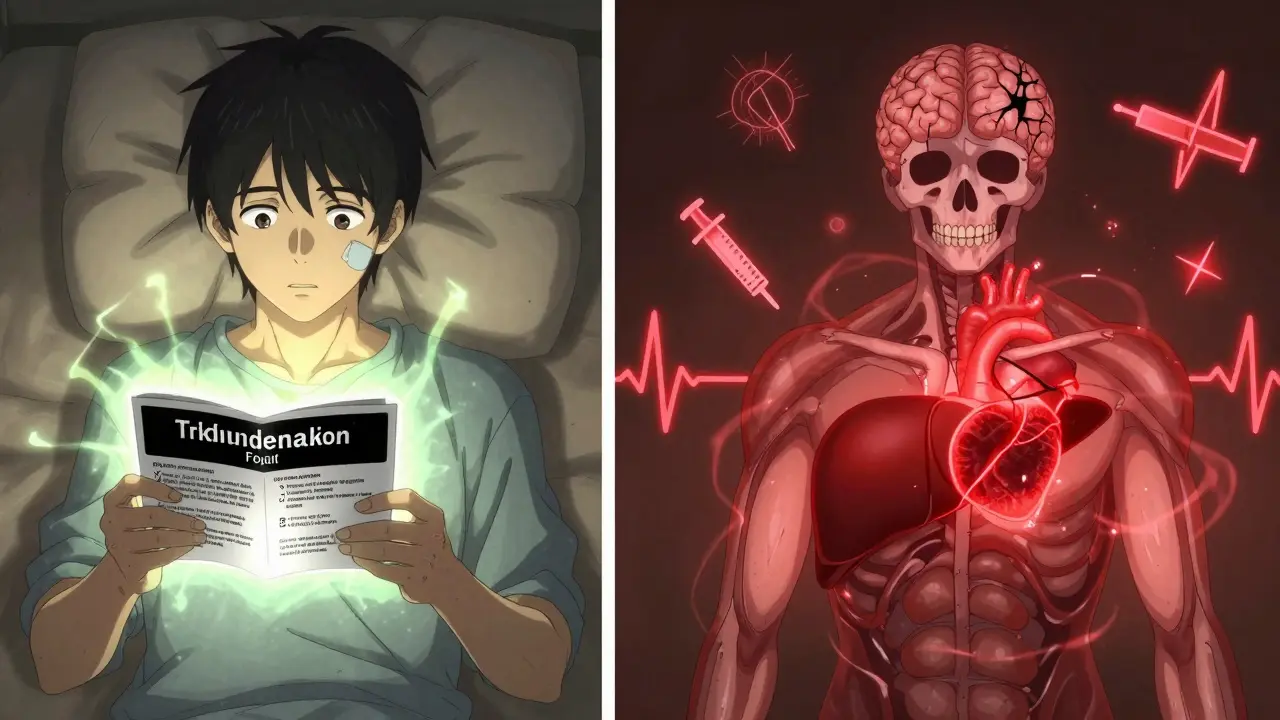
- What’s the exact risk? Is it liver damage? Heart attack? Suicidal thoughts? Don’t accept vague answers. Get the specific term.
- Are you at higher risk? Age, genetics, other health conditions, or other meds you take can make you more vulnerable. Ask: "Does my medical history make this risk more likely?"
- What signs should you watch for? For example, if you’re on a drug with a liver warning, you might need to look for yellow skin, dark urine, or extreme fatigue. Write them down.
- What monitoring is required? Many drugs with black box warnings need regular blood tests, EKGs, or doctor visits. Find out how often and who will track it.
- Are there safer alternatives? Ask if another drug in the same class has fewer risks. Sometimes, yes.
Doctors should use the "teach-back" method: after explaining the warning, they ask you to repeat it in your own words. If you can’t, they haven’t explained it well enough.
What Happens If You Ignore the Warning?
Real stories show the consequences.
In 2023, a patient taking methotrexate for rheumatoid arthritis didn’t get monthly blood tests, as required by the drug’s black box warning. After six months, they developed severe liver damage. The warning had been there for 25 years-but without monitoring, it meant nothing.
Another case: a woman prescribed an antidepressant with a suicide risk warning didn’t understand it applied to her age group. She stopped taking it abruptly when she felt worse, then tried to overdose. Her doctor later admitted they never discussed the warning properly.
On the flip side, many patients use these drugs safely. A study of 1,247 people on blood thinners with bleeding warnings found 78% stayed on the medication after their doctor explained the risks and set up a monitoring plan. The key? Understanding, not fear.
Can You Report Problems With These Drugs?
Yes-and you should.
The FDA runs a system called MedWatch. It lets patients report side effects, errors, or problems directly. You don’t need a doctor’s note. Just fill out Form 3500 online or by mail. In 2022 alone, over 2 million reports came in.
These reports help the FDA spot new patterns. Maybe 10 people report the same rare reaction. That’s not enough to pull a drug, but it might lead to a revised warning, better monitoring guidelines, or even a new boxed warning.
Don’t assume your report won’t matter. One patient’s report about a diabetes drug causing severe urinary infections led to a new boxed warning in September 2023.
Are Boxed Warnings Always Clear or Fair?
Not always.
Some experts say these warnings are too broad. For example, a black box warning might say "increased risk of heart attack" without saying which patients are most at risk. That can scare doctors into avoiding the drug even for patients who would benefit.
Studies show that while boxed warnings reduce inappropriate use by 15-25%, they also reduce appropriate use by 10-20%. That’s a real problem. Patients with life-threatening conditions may miss out on effective treatments because doctors are afraid of liability.
And sometimes, the warning doesn’t match the science. A 2021 report found that many boxed warnings were based on weak evidence-sometimes just a handful of case reports.
That’s why the FDA is now testing plain-language summaries. Instead of medical jargon, they’re trying to write warnings like: "This drug can cause sudden liver failure in people with hepatitis B. If you have it, tell your doctor before starting. You’ll need a blood test first."
What Resources Can Help You Understand These Risks?
You don’t have to figure this out alone.
- Consumer Reports Best Buy Drugs compares medications in the same class and rates them by safety, effectiveness, and cost. Updated every quarter.
- Drug Effectiveness Review Project (DERP) gives independent analysis of whether a drug’s benefits outweigh its risks.
- PatientsLikeMe lets you read real stories from others taking the same drug. Look for trends: "Did anyone else have this side effect?"
- Your pharmacist is a hidden resource. They read the full prescribing info. Ask them to explain the boxed warning in plain terms.
Remember: a black box warning doesn’t mean "don’t take this." It means "take this carefully, with full awareness."
What’s Changing in the Future?
The FDA is moving toward more personalized warnings. Instead of one-size-fits-all alerts, they’re testing systems that tailor risks to your age, genetics, and other meds you take.
The Sentinel Initiative now tracks real-time data from over 300 million Americans’ electronic health records. That means future warnings could come faster-based on actual patient outcomes, not just delayed case reports.
But challenges remain. A 2023 government report found that only 60% of required safety studies for black box drugs were completed on time. That’s a gap in the system.
For now, your best defense is knowledge. Ask questions. Demand clarity. Keep records. And never assume a warning means the drug is off-limits-just that it needs your attention.


jefferson fernandes
January 14, 2026 AT 05:30Black box warnings aren’t scary-they’re essential. I’ve seen patients die because doctors skipped the fine print. If your med has a black box, you need to know the exact risk, the monitoring schedule, and the warning signs. No vague answers. No "it’s probably fine." You’re not being paranoid-you’re being responsible.
I work in pharmacy. I’ve watched people panic and quit meds cold turkey, then end up in the ER. Others ignore the warnings entirely. Neither extreme helps. The middle path? Ask questions. Get blood tests. Track symptoms. Keep a log. You’re not a statistic-you’re a person with agency.
And yes, the system’s slow. Rofecoxib? Too late. But now? We have Sentinel. Real-time data. That’s progress. Don’t dismiss the warnings because they’re imperfect-demand better ones. Push for plain language. Ask your pharmacist to explain it in words you understand.
And if your doctor won’t take five minutes to walk you through it? Find a new one. Your life isn’t a gamble.
Pankaj Singh
January 16, 2026 AT 02:19This is why I hate American healthcare. You get a drug that kills 0.2% of users but the FDA drags its feet for 7 years? Meanwhile, people are dropping dead while bureaucrats debate semantics. The system isn’t broken-it’s designed to protect Big Pharma, not patients. You think they’d rush a warning if it was a Chinese drug? Please.
And don’t get me started on how doctors use these warnings as a shield. "Oh, it has a black box"-that’s not an explanation, that’s a cop-out. They don’t want to explain risk-benefit ratios. They just want to check a box and move on.
Meanwhile, patients are left to Google symptoms at 3 a.m. while their liver fails. This isn’t safety. It’s negligence dressed up in bureaucracy.
Trevor Davis
January 17, 2026 AT 23:28Hey, I just want to say-thank you for writing this. I’ve been on methotrexate for 4 years. I didn’t know about the liver monitoring until my pharmacist sat me down and said, "You’re not just taking a pill-you’re signing up for a weekly blood test."
I used to think the black box was just scare tactics. Turns out, it saved my life. I had a spike in ALT levels last year. Caught it early. Adjusted my dose. Still on it. Still alive.
People need to know: this isn’t about fear. It’s about awareness. And if your doctor doesn’t treat it that way? Find someone who does.
Kimberly Mitchell
January 19, 2026 AT 02:55The FDA’s boxed warning system is a performative gesture masquerading as patient safety. It creates the illusion of control while doing nothing to address systemic failures in post-market surveillance. The fact that 70% of these warnings emerge years after market approval indicates a catastrophic failure of pharmacovigilance infrastructure, not a lack of patient diligence.
Moreover, the over-reliance on black boxes as a regulatory crutch allows pharmaceutical companies to offload responsibility onto clinicians and patients, while continuing to profit from drugs with known, preventable risks. The absence of mandatory real-time adverse event reporting integration with EHRs is a scandal.
And yet, we praise the system as "rigorous." It’s not. It’s reactive, underfunded, and politically compromised.
Vinaypriy Wane
January 20, 2026 AT 21:11I’m from India. We don’t have FDA here-but we have the same drugs. Same black boxes. Same silence from doctors.
I had a cousin on an antipsychotic. No one told her about the risk of tardive dyskinesia. She started shaking uncontrollably after 18 months. By then? Irreversible.
It’s not just America. It’s everywhere. Doctors are overworked. Patients are afraid to ask. Pharma pushes the pills. The warning is there-but nobody reads it. Or worse-they read it, but don’t believe it applies to them.
Someone needs to translate these warnings into every language. And train nurses, not just doctors, to explain them. Not just once-but again, and again.
Diana Campos Ortiz
January 21, 2026 AT 16:22I’m not a doctor, but I’ve been on 3 drugs with black boxes. One for anxiety, one for diabetes, one for RA. I kept a notebook. Wrote down every side effect. Took my blood work every week. Asked my pharmacist to explain the warning in plain words.
It’s not hard. It’s just… inconvenient. And most people don’t want to be inconvenienced.
But here’s the thing: if you’re willing to take the pill, you owe it to yourself to understand the risk. Not because the FDA says so. Because you’re the one living with it.
And yeah, I still take them. Because I did the work. And it’s worth it.
Jesse Ibarra
January 23, 2026 AT 02:39Let’s be real: if you’re taking a drug with a black box warning, you’re already playing Russian roulette. The FDA doesn’t care about you. They care about lawsuits. Your doctor cares about their liability. Your pharmacist? They’re just filling prescriptions.
And don’t tell me about "monitoring"-how many people actually get those blood tests? How many doctors even know what to look for? The system is designed to make you feel safe while quietly killing you.
I’ve seen it. My uncle took a diabetes drug. They told him it was "safe." He died of heart failure. The warning had been there for 12 years. No one cared.
Stop pretending this is about safety. It’s about profit. And you’re the cost of doing business.
Scottie Baker
January 23, 2026 AT 03:31Okay but what if you’re just a broke person with no insurance? You get prescribed this drug with the black box, but you can’t afford the monthly labs? What then? Do you just stop? Or do you take it and hope?
I’m not saying don’t take the meds-I’m saying the system doesn’t give a damn if you live or die as long as the prescription gets filled.
My mom’s on one of these. She skips her labs because they cost $300. She doesn’t tell her doctor. She just keeps taking it. And now she’s scared to even talk about it.
So yeah. Great article. But who’s gonna fix the part where people can’t afford to be safe?
Anny Kaettano
January 24, 2026 AT 12:32Black box warnings are not the enemy. They’re the last line of defense in a broken system. And yes, they’re often too vague. And yes, they come too late. But they’re still the only thing forcing manufacturers to admit their drugs can kill.
I’ve worked in patient advocacy for 15 years. I’ve seen people die because they didn’t know the risk. I’ve seen people live because they did.
The answer isn’t to scrap the warnings. It’s to improve them. Make them plain. Make them mandatory in every ad. Make them part of every prescription refill reminder. Make them something your pharmacist reads aloud when you pick up the bottle.
We can do better. We just have to care enough to demand it.
Angel Molano
January 25, 2026 AT 12:09Stop taking drugs with black boxes.