
Milk Thistle Medication Risk Checker
Check Your Medication Risk
Enter your medications to see potential interactions with milk thistle based on liver enzyme activity
People take milk thistle for their liver. It’s popular. It’s natural. And for many, it works. But what happens when you’re also taking prescription drugs that your liver has to process? That’s where things get tricky - and not everyone knows it.
How Milk Thistle Actually Works in Your Liver
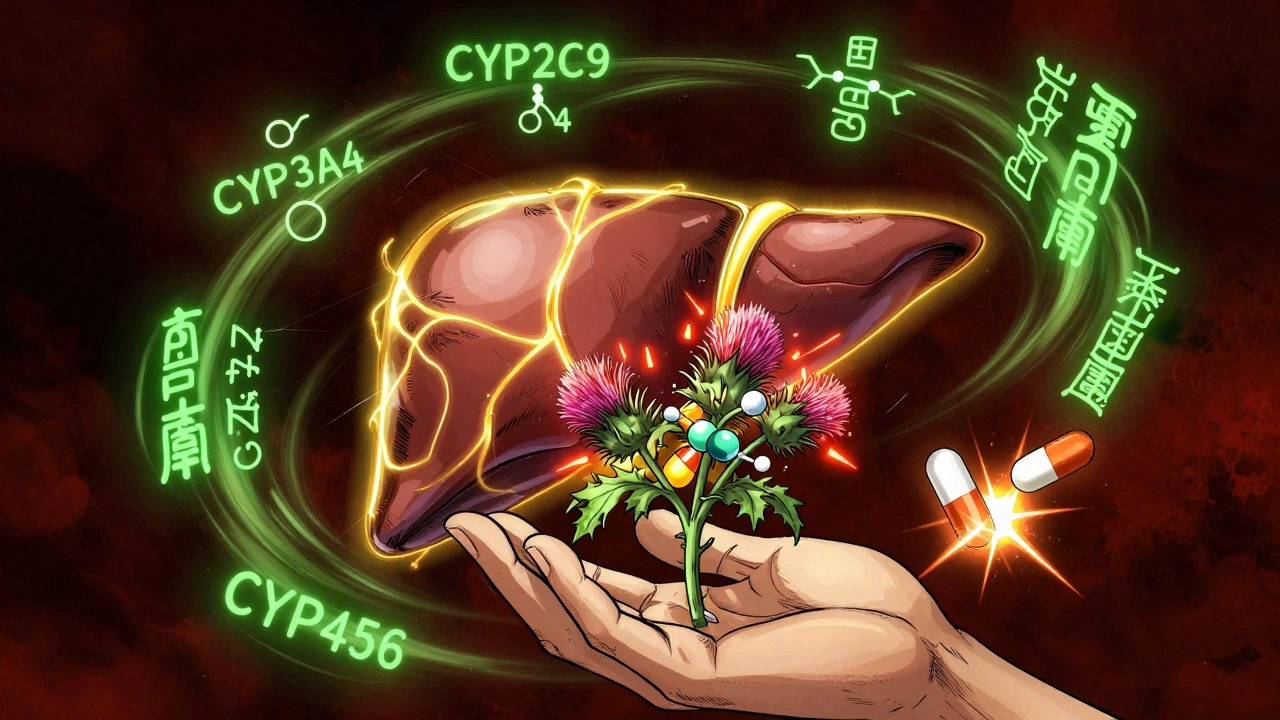
Milk thistle’s main active ingredient is silymarin, a mix of compounds like silybin, silychristin, and silydianin. It’s been used for centuries, but modern science started taking it seriously in the 1960s. Today, most supplements contain 70-80% silymarin, with typical doses ranging from 140 mg to 420 mg daily. That’s what most clinical studies use. The liver is your body’s main detox hub. It uses enzymes - especially the CYP450 family - to break down drugs, toxins, and even some vitamins. Silymarin doesn’t just sit there and protect liver cells. It talks to those enzymes. And that’s where the real risk lies.The Enzymes That Matter: CYP2C9, CYP3A4, CYP2D6
Not all liver enzymes behave the same way with milk thistle. Three are most important:- CYP2C9: Handles warfarin, phenytoin, and some NSAIDs. Studies show silymarin can inhibit this enzyme by 15-23% in lab settings. That means drugs processed by CYP2C9 might build up in your blood.
- CYP3A4: Processes over half of all prescription drugs - statins, blood pressure meds, immunosuppressants, even some antidepressants. Some studies say milk thistle barely touches it. Others suggest a small effect. The truth? It’s messy.
- CYP2D6: Involved in metabolizing beta-blockers, SSRIs, and opioids. Data here is thin, but not enough to rule out risk.
Real-World Cases: When Things Go Wrong
Lab results don’t always match what happens in real people. On Reddit, a user wrote: “I started milk thistle for fatty liver. Two weeks later, my INR jumped from 2.1 to 4.8. I almost bled out.” That’s not rare. Over 40 people on that same thread reported similar INR spikes while on warfarin. Some needed their warfarin dose cut by 20-35% just to get back to safe levels. The FDA’s database has 47 reports of possible milk thistle interactions between 2018 and 2023. Only nine were confirmed. But that doesn’t mean the others didn’t happen. Many go unreported. People don’t connect the dots. They don’t tell their doctor they’re taking a “natural” supplement. Meanwhile, on Amazon, 98% of reviews say milk thistle helped their energy or liver feel better. Only 2% mention drug interactions. That’s the disconnect: people feel good, so they assume it’s safe. But feeling good doesn’t mean your liver isn’t struggling to keep up with your meds.How It Compares to Other Liver Supplements
Not all herbal liver supports are the same.- NAC (N-acetylcysteine): Boosts glutathione, a key antioxidant. Doesn’t touch CYP enzymes. Very predictable. Used in hospitals for acetaminophen overdose.
- Artichoke extract: Also inhibits CYP2C9, but more consistently. Less variable than milk thistle.
- Ursodeoxycholic acid: A pharmaceutical bile acid. Proven for liver disease. But it has side effects - diarrhea, weight gain, and a higher rate of adverse events than milk thistle.

Who’s at the Highest Risk?
Not everyone needs to panic. But some people should be extra careful:- Those on warfarin - even a 10% change in metabolism can lead to bleeding or clots.
- People taking phenytoin (for seizures) - levels must stay tight. Too high = dizziness, tremors. Too low = seizures.
- Transplant patients on immunosuppressants like cyclosporine or tacrolimus - tiny changes can trigger rejection.
- Anyone on statins metabolized by CYP3A4 - like simvastatin or atorvastatin - though clinical evidence here is weak, the theoretical risk is real.
What the Experts Disagree On
There’s no consensus. That’s the problem. Dr. Joseph Pizzorno, a leading voice in natural medicine, says the risk is exaggerated. He points to only 12 case reports in 40 years - and none proved causation. Dr. David Bernstein, a top hepatologist, says: “Until we have consistent data, treat it like a drug. Assume it interacts.” The European Medicines Agency says: “No clinically relevant interactions expected.” The U.S. NIH’s LiverTox database says: “Possibly interacting with CYP2C9 substrates.” Why the split? Because the science is messy. Doses vary. Extracts aren’t standardized. People’s genes differ. One person’s CYP2C9 enzyme might be 50% more sensitive to silymarin than another’s. Genetic testing could help - but it’s not routine.What You Should Do Right Now
If you’re taking milk thistle and any prescription drug:- Don’t stop your meds. That’s dangerous.
- Don’t assume it’s safe just because it’s herbal.
- Check your labels. Only 32% of milk thistle supplements meet their label claims. You might be getting less - or more - than you think.
- Ask your doctor for a drug level test if you’re on warfarin, phenytoin, or immunosuppressants. Do it before starting milk thistle, and again after 2 weeks.
- Wait 48 hours after stopping milk thistle before testing drug levels. That’s the standard window for enzyme effects to clear.





Ben Greening
December 11, 2025 AT 03:55Milk thistle's effect on CYP enzymes is fascinating from a pharmacokinetic standpoint. The biphasic modulation-initial inhibition followed by induction-isn't unique to silymarin, but it's unusually pronounced in this case. The 12.7% increase in CYP2C9 activity after 28 days is clinically significant enough to warrant monitoring, especially with narrow-therapeutic-index drugs. Most patients assume herbal means inert, but the liver doesn't distinguish between botanicals and pharmaceuticals at the enzymatic level.
It's also worth noting that silymarin's bioavailability varies wildly between formulations. Phosphatidylcholine-bound silybin, as mentioned, has higher absorption but may also amplify enzyme interactions. Standardized extracts aren't a guarantee of consistency-manufacturing variability remains a major blind spot in herbal supplement regulation.
Nikki Smellie
December 12, 2025 AT 07:57Let me ask you something-how many of these ‘studies’ are funded by Big Pharma? The EMA says ‘no clinically relevant interactions’? That’s the same agency that approved Vioxx. The NIH LiverTox database says ‘possibly interacting’-which is a polite way of saying ‘we’re scared but won’t say it outright.’
And why are there only 47 FDA reports? Because doctors don’t ask. Patients don’t report. The system is designed to ignore what doesn’t fit the drug model. Milk thistle is a threat to the pharmaceutical monopoly. They’d rather you take warfarin and pay $200/month than save your liver naturally and save them money.
They’re not protecting you. They’re protecting profits.
And yes-I’ve seen the INR spikes. I’ve seen the patients. They’re not outliers. They’re the canaries in the coal mine.
And no-I won’t stop taking my milk thistle. Not until they prove the drugs are safe.
David Palmer
December 13, 2025 AT 12:45Doris Lee
December 14, 2025 AT 16:03Thank you for writing this. So many people think ‘natural’ means ‘safe’ and it’s not true. I’ve seen friends get hurt because they assumed herbs couldn’t interfere with meds.
If you’re on anything that needs precise dosing-warfarin, seizure meds, transplant drugs-please talk to your pharmacist. They’re the real heroes here. Not the Amazon reviews. Not the Instagram influencers. The pharmacist.
You’re not being paranoid. You’re being smart.
And if you’re just taking milk thistle for general wellness? That’s fine. But stay curious. Stay informed. You’ve got this.
Jack Appleby
December 15, 2025 AT 06:23It’s amusing how laypersons conflate ‘natural’ with ‘non-pharmacological.’ Silymarin is a polyphenolic flavonolignan complex with demonstrated affinity for cytochrome P450 isoforms-this is not folklore. It is biochemistry.
Furthermore, the assertion that ‘only 1.2% had side effects’ is statistically misleading. Adverse events in herbal supplements are underreported by orders of magnitude. The 47 FDA reports? That’s the tip of an iceberg submerged in apathy and ignorance.
And to those who say ‘I feel better’-so did the patients who took thalidomide. Feeling good is not a biomarker of safety. It is a biomarker of placebo and confirmation bias.
Read the original 2020 study: the enzyme induction was dose- and time-dependent. That’s not a bug. It’s a feature of pharmacokinetic complexity. If you can’t handle that, don’t self-prescribe.
Rebecca Dong
December 15, 2025 AT 23:15Okay but what if I told you the FDA is hiding the truth? I read a whistleblower blog that said the NIH has a secret report showing milk thistle causes liver cancer in rats at high doses-and they buried it because it’s too popular.
And the ‘47 reports’? That’s just the ones they didn’t delete. I know a guy whose aunt died after taking milk thistle with her chemo. They said it was ‘unrelated.’
They don’t want you to know. They want you to keep buying the drugs. The supplements are a trap. They make you feel like you’re doing something, but you’re just handing your liver to Big Pharma.
And don’t even get me started on how they regulate ‘standardized extracts.’ That’s just marketing. There’s no standard. None.
I’m not taking it anymore. I’m going back to the old ways. Water. Rest. No pills. No herbs. Just nature.
Regan Mears
December 16, 2025 AT 07:59Thank you for this. Seriously. I’ve been on warfarin for 12 years. I started milk thistle because my doctor said ‘it’s fine.’ Then my INR went from 2.5 to 5.1 in 10 days. I ended up in the ER.
I didn’t know supplements could do this. I thought they were like vitamins.
Now I tell everyone: if you’re on meds that need blood tests-warfarin, phenytoin, cyclosporine-don’t touch anything herbal without checking with your pharmacist first.
And if you’re feeling guilty because you took it? Don’t. You didn’t know. Now you do. That’s all that matters.
You’re not alone. I’ve been there. We’re all learning.
Neelam Kumari
December 16, 2025 AT 10:57How can you even trust Western medicine? You take a supplement from a country that doesn’t regulate it, then you expect a doctor who barely understands herbs to tell you what’s safe?
Real medicine is Ayurveda. Ayurveda has been treating liver for 5,000 years. Milk thistle? It’s a Western fad. You think silymarin is magic? Try kutki. Or bhumiamla. Or kalmegh. These are real herbs. Real science. Real tradition.
And you think the FDA knows better? They approved aspartame. They approved glyphosate.
Why are you trusting them with your liver?
Stephanie Maillet
December 18, 2025 AT 05:10There’s something poetic about this whole situation: we’ve created a world where we treat the body like a machine, then we hand it a plant that’s been evolving for millions of years, and we’re shocked when it doesn’t behave predictably.
Silymarin doesn’t ‘interact’ with enzymes. It participates in a conversation the body has been having since before antibiotics.
Our mistake isn’t taking milk thistle. Our mistake is assuming we can control biology with labels and doses. The liver doesn’t read supplement facts. It feels rhythm. It responds to pattern. It remembers.
Maybe the real question isn’t ‘does it interact?’
But: ‘are we listening?’
Michaux Hyatt
December 19, 2025 AT 08:25Hey-just wanted to say thank you for writing this. I’m a pharmacist and I see this all the time. People come in saying ‘I’m fine, I’m just taking milk thistle.’ Then we check their INR and it’s off the charts.
Here’s the thing: if you’re on warfarin, phenytoin, or immunosuppressants, treat milk thistle like a drug. Period.
And if you’re not on meds? Cool. Enjoy it. But don’t assume it’s harmless forever. Your body changes. Your meds change. Your liver changes.
Check in with your pharmacist every 6 months. Even if you think it’s fine.
You’re not being paranoid. You’re being responsible.
Raj Rsvpraj
December 20, 2025 AT 01:53Western medicine is a joke. In India, we’ve used neem, amla, and karela for liver detox for centuries. No one dies from milk thistle interactions because we don’t use it. We use real herbs. Real wisdom.
And you think the FDA knows anything? They approved glyphosate as safe. They approved opioids. They approved the same chemicals that cause cancer.
Why are you trusting them? Why are you trusting a system that profits from your illness?
Milk thistle is not the problem. The system is.
Go back to Ayurveda. Go back to tradition. Stop listening to Western lies.
Frank Nouwens
December 20, 2025 AT 03:30While the pharmacokinetic data on silymarin’s modulation of CYP2C9 and CYP3A4 is compelling, it remains context-dependent. The variability in extract composition, dosage regimens, and individual genetic polymorphisms (e.g., CYP2C9*2, *3 alleles) renders population-level generalizations inadequate.
Moreover, the 2020 study demonstrating enzyme induction after 28 days was conducted with a 420 mg/day dose of 80% silymarin-far exceeding the average consumer’s intake. Most supplements contain 140–210 mg. The clinical relevance of induction at lower doses remains speculative.
That said, caution is prudent. The risk-benefit calculus must be individualized. For the vast majority of healthy individuals not on narrow-therapeutic-index drugs, the risk is negligible. For the minority who are? The data is clear: monitor.
Kaitlynn nail
December 21, 2025 AT 01:19Michelle Edwards
December 22, 2025 AT 16:02I’ve been taking milk thistle for fatty liver for 2 years. My ALT dropped from 85 to 38. I didn’t tell my doctor because I didn’t want him to tell me to stop.
But then I started a new blood pressure med last month. I’ve been feeling a little off-headaches, fatigue.
I’m going to pause the milk thistle this week and get my levels checked. I’m not scared. I’m just being careful.
Thank you for reminding me that it’s okay to check in. That’s not weakness. That’s wisdom.
Sarah Clifford
December 23, 2025 AT 19:41Okay but what if I told you the real reason milk thistle is ‘dangerous’ is because it’s too cheap? If everyone started using milk thistle instead of warfarin, the pharmaceutical industry would lose billions.
They made up the ‘interaction’ thing to scare people. It’s not science. It’s marketing.
And don’t even get me started on how they say ‘no standardization’-but they standardize every single drug. Why? Because they control the supply chain.
They don’t want you to heal yourself.
I’m not stopping my milk thistle. I’m doubling down.
They can’t control nature.