
Waking up gasping for air is terrifying. If you’ve been diagnosed with a sleep disorder like obstructive sleep apnea (OSA), your doctor has likely prescribed a machine that blows air into your face while you sleep. But here’s the confusing part: there are different machines, and they have different names. You might hear about CPAP or BiPAP. They look similar, but they work differently, cost different amounts, and aren’t always interchangeable.
Picking the wrong one can mean bad nights of sleep, expensive equipment sitting in a drawer, or worse-untreated health risks. So, which one is right for you? The short answer is that most people start with CPAP. It’s simpler, cheaper, and effective for standard cases. BiPAP is the heavy-duty option reserved for complex breathing issues or when CPAP just doesn’t cut it. Let’s break down exactly why, how they differ technically, and what the medical guidelines say about who needs what.
How CPAP and BiPAP Actually Work
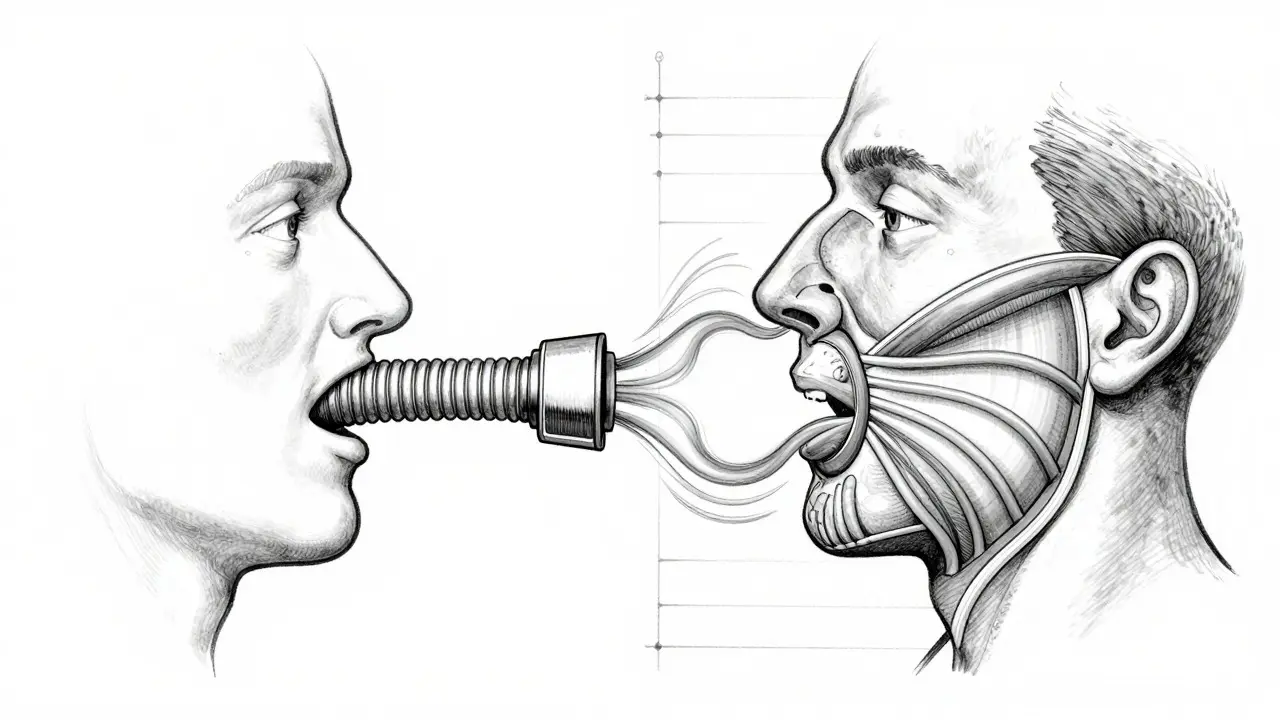
To understand the difference, you first need to understand what these machines do. Both Continuous Positive Airway Pressure (CPAP) is a device that delivers a single, constant stream of pressurized air through a mask to keep your airway open during sleep. Think of it like an air mattress. Once it’s inflated, it stays firm. That constant pressure prevents the soft tissues in your throat from collapsing and blocking your breathing.
Bilevel Positive Airway Pressure (BiPAP) is a more advanced ventilation device that provides two different pressure levels: higher pressure when you inhale and lower pressure when you exhale. This is where the "Bi" comes from-two levels. Instead of fighting against a constant wall of air every time you breathe out, the machine senses your exhalation and drops the pressure slightly. It makes exhaling feel more natural, like breathing through a straw that gets wider when you blow out.
Historically, CPAP was pioneered in 1981 by Dr. Colin Sullivan in Sydney, Australia, specifically for OSA. BiPAP technology followed in the late 1980s and early 1990s as engineers realized some patients couldn’t tolerate the constant resistance of CPAP. Today, modern devices from brands like ResMed and Philips Respironics use sensors to switch pressures in milliseconds, but the core mechanical difference remains: one pressure versus two.
Technical Specifications and Pressure Settings
The numbers matter here. Understanding the pressure ranges helps explain why one machine might be prescribed over the other.
| Feature | CPAP | BiPAP |
|---|---|---|
| Pressure Type | Single constant pressure | Two distinct pressures (IPAP & EPAP) |
| Typical Range | 4-25 cm H2O | IPAP: 8-30 cm H2O; EPAP: 4-25 cm H2O |
| Minimum Differential | N/A | At least 3 cm H2O between IPAP and EPAP |
| Breathing Support | Passive (user must initiate breath) | Can include backup rate (S/T mode) for central apnea |
| Complexity | Low (set-and-forget) | High (requires careful titration of multiple settings) |
In CPAP, if your prescription is 10 cm H2O, the machine pushes 10 units of pressure whether you’re inhaling or exhaling. In BiPAP, your doctor might set the Inspiratory Positive Airway Pressure (IPAP) to 12 and the Expiratory Positive Airway Pressure (EPAP) to 8. That 4-unit drop on exhalation reduces the "work of breathing" by 30-40%, according to clinical studies. For someone with weak lung muscles or high pressure requirements, this relief is massive.
Clinical Indications: Who Needs Which Device?
This is the most critical section. Just because BiPAP is "more advanced" doesn’t mean it’s better for everyone. In fact, using BiPAP when you don’t need it can introduce unnecessary complexity and cost.
CPAP is the first-line therapy for approximately 85-90% of patients with Obstructive Sleep Apnea (OSA). If you have standard OSA-where your airway collapses due to tissue relaxation-CPAP is usually all you need. It’s simple, effective, and widely covered by insurance.
BiPAP is indicated for specific, more complex scenarios:
- High Pressure Requirements: If you need pressures above 15 cm H2O to keep your airway open, exhaling against that constant force becomes exhausting. BiPAP lowers the expiratory pressure, making it tolerable.
- COPD Overlap Syndrome: Patients with both Chronic Obstructive Pulmonary Disease (COPD) and OSA often retain carbon dioxide (hypercapnia). BiPAP helps flush out CO2 more effectively than CPAP.
- Central Sleep Apnea (CSA): Unlike OSA, CSA is a brain-signaling issue where you forget to breathe. Some BiPAP modes (like S/T) provide a backup breathing rate if you stop initiating breaths, which CPAP cannot do.
- Obesity Hypoventilation Syndrome (OHS): For patients with a BMI ≥30 and daytime high CO2 levels, BiPAP supports lung expansion better than CPAP.
- Neuromuscular Disorders: Conditions like ALS or muscular dystrophy weaken respiratory muscles. BiPAP assists the inhalation phase, reducing fatigue.
Dr. David White, former president of the American Academy of Sleep Medicine, notes that BiPAP should be reserved for these specific indications. Using it for simple OSA adds complexity without significant benefit for most users.
Cost, Insurance, and Market Reality
Money is a practical concern. BiPAP machines are generally more expensive upfront and harder to get approved by insurance providers.
As of mid-2023, basic CPAP models like the ResMed AirSense 10 retail around $899, while BiPAP models like the Philips DreamStation BiPAP Auto sell for roughly $1,499. However, out-of-pocket costs depend heavily on insurance.
In the US, Medicare and many private insurers follow strict rules. To get coverage for BiPAP, you typically must prove "documented CPAP failure." This means showing records that you tried CPAP at pressures ≥15 cm H2O for at least 4 hours a night over 30 days, and still had residual events or couldn’t tolerate the pressure. Without this documentation, insurers will often deny the BiPAP claim, forcing you to pay the full price.
The global market reflects this divide. CPAP dominates with about 68% of the PAP therapy segment ($5.3 billion in 2022), while BiPAP holds 22% ($1.7 billion). However, BiPAP sales are growing faster (9.2% CAGR) due to aging populations and rising rates of complex sleep disorders.
User Experience: Comfort vs. Complexity
Data from user surveys reveals a clear trade-off. CPAP users report higher satisfaction with ease of use. In a 2023 survey of over 12,000 users, 78% of CPAP users were satisfied, compared to 72% of BiPAP users. Why? Simplicity. CPAP has fewer settings to mess up. You put the mask on, turn it on, and go to sleep.
BiPAP users, however, often report better adherence *once* they are acclimated. Among those with specific indications (like high pressure needs), 68% used their BiPAP for 6+ hours a night, compared to 62% of CPAP users. One common sentiment from online communities is that BiPAP feels "normal" because you aren’t fighting the machine on exhalation. A user on Reddit described switching from CPAP at 14 cm H2O to BiPAP at 14/8 as feeling like "breathing normally" instead of "choking."
But BiPAP has a steeper learning curve. 34% of BiPAP users struggle with mode settings, compared to only 18% of CPAP users. Issues like "machine cycling"-where the device doesn’t sync perfectly with your breathing rhythm-can cause discomfort and anxiety. Proper mask fitting is crucial for both, but BiPAP requires more precise adjustments to ensure the pressure switch happens smoothly.
Setup, Titration, and Long-Term Care
You can’t just buy these machines off the shelf and guess the settings. Both require a formal sleep study (polysomnography) to determine the correct pressure.
CPAP Titration: Usually takes one overnight session. A technician adjusts the single pressure until your apneas stop. It’s straightforward.
BiPAP Titration: Can take 1.5 to 2 nights. Technicians must find the right balance between IPAP and EPAP, ensuring the differential is at least 3 cm H2O while avoiding over-breathing or under-support. If you have central apnea, they may also set a backup rate (e.g., 12-15 breaths per minute).
Maintenance is similar for both: clean masks daily, replace filters monthly, and change tubing every few months. However, BiPAP users often need more frequent follow-ups with respiratory therapists to fine-tune settings, especially if their underlying condition (like COPD) changes.
Future Trends and Smart Technology
The landscape is evolving. Manufacturers are integrating AI into these devices. ResMed’s AirCurve 10 VAuto and Philips’ upcoming DreamStation 3 use algorithms to adjust pressures in real-time based on biometric feedback. This "smart" adjustment could blur the lines between CPAP and BiPAP, potentially offering bilevel-like comfort within simpler interfaces. However, reimbursement policies lag behind technology, so for now, the distinction remains clinically and financially significant.
Can I switch from CPAP to BiPAP on my own?
No. Switching requires a new prescription and often a new sleep study. BiPAP settings are complex; incorrect IPAP/EPAP ratios can worsen breathing patterns or reduce therapy effectiveness. Always consult your sleep specialist before changing devices.
Is BiPAP better than CPAP for snoring?
Not necessarily. Snoring is often caused by mild OSA, which CPAP treats effectively. BiPAP is overkill for simple snoring unless you have other comorbidities like COPD or high pressure intolerance. Start with CPAP unless advised otherwise.
Why does my insurance deny my BiPAP request?
Most insurers require proof of CPAP failure. You must show documented usage of CPAP at high pressures (≥15 cm H2O) for 30 days with continued symptoms or intolerance. Without this data, they view BiPAP as medically unnecessary.
Do BiPAP machines help with weight loss?
Indirectly. Better sleep improves energy levels and hormonal balance, which can aid weight management. However, neither CPAP nor BiPAP directly burns calories. Weight loss is a separate lifestyle intervention that often reduces the severity of OSA, potentially allowing you to lower pressure settings.
What is the difference between S/T and ST-Auto modes on BiPAP?
S/T (Spontaneous/Timed) mode provides a backup breathing rate if you stop breathing, while keeping pressure fixed. ST-Auto (or VAuto) automatically adjusts the IPAP and EPAP levels based on real-time obstruction detection, similar to APAP but with bilevel support. ST-Auto is more adaptive but also more complex.