
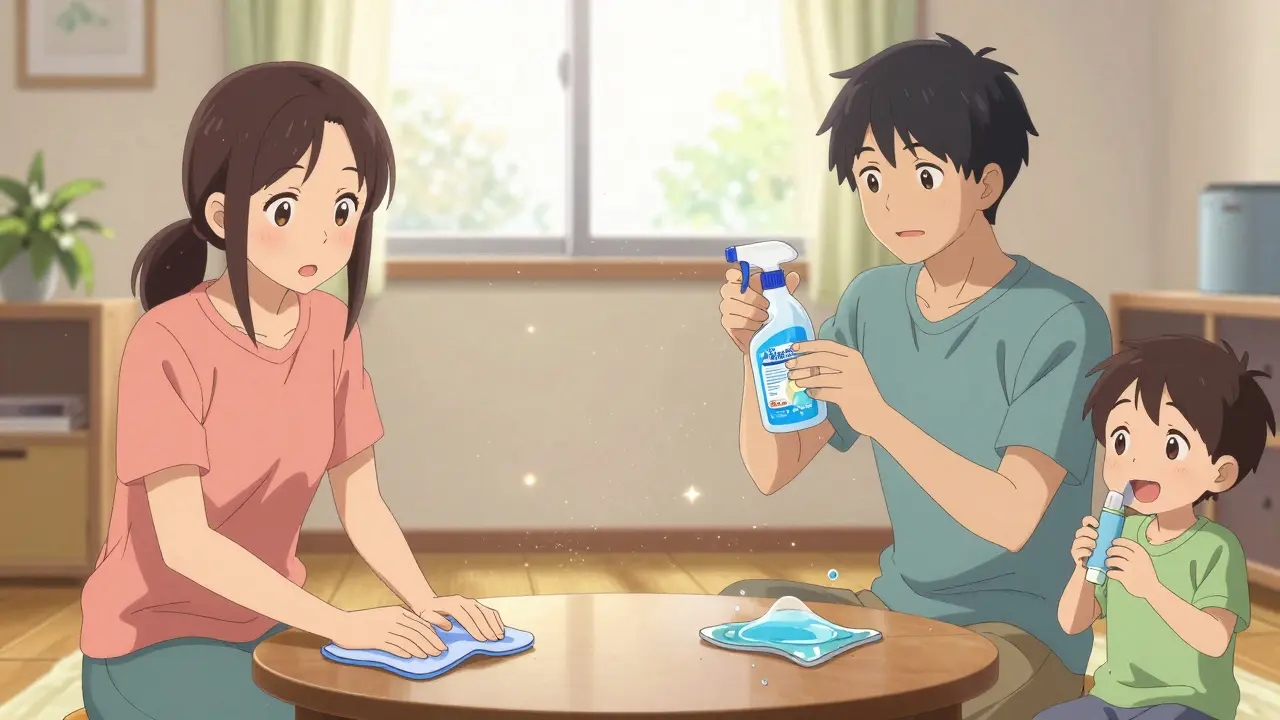
Every time you clean your home, you might be making your allergies worse - even if you think you’re doing the right thing. Dry dusting? It kicks up pollen and pet dander. Spraying a ‘natural’ cleaner? It could be hiding fragrance chemicals that trigger sneezing, wheezing, or skin rashes. If you or someone in your home has asthma or allergies, the products you use matter more than you think. And not all ‘green’ or ‘fragrance-free’ labels mean what they say.
The truth is, most conventional cleaners don’t remove allergens - they just move them around. Studies show that even after wiping down a counter five times with a regular cloth, 87% of peanut, milk, and egg residues remain. That’s not cleaning. That’s spreading. And for people with food allergies or respiratory conditions, that’s dangerous.
What Makes a Cleaner Truly Allergy-Friendly?
An allergy-friendly cleaner isn’t just one without perfume. It’s been tested, measured, and proven to do three things: remove allergens, avoid triggering reactions, and not release harmful fumes. The gold standard is the Asthma & Allergy Friendly® a certification program run by the Asthma and Allergy Foundation of America that requires products to remove over 85% of common allergens like dust mites, pet dander, and pollen while keeping VOC emissions below 0.5 parts per million. This isn’t marketing fluff. It’s science.
Products with this certification go through real-world testing in labs. They’re sprayed on surfaces coated with allergens, then cleaned using the exact method listed on the label. If they remove less than 85% of allergens? They don’t get certified. That’s why Renegade Brands’ Sweat-X Free & Clear detergent removes 92% of allergens - compared to just 76% for typical ‘natural’ brands.
Look at the ingredients. Effective allergy-friendly cleaners use:
- Potassium cocoate (5-15%) - a gentle surfactant made from coconut oil that lifts dirt without irritating skin or lungs.
- Potassium citrate (2-8%) - softens water and helps break down mineral buildup without harsh chemicals.
- Ethanol from corn (10-20%) - a renewable solvent that cuts grease safely, unlike ammonia or bleach.
- Hydrogen peroxide (3-5%) - a mild oxidizer that kills germs without releasing toxic fumes.
These are the building blocks of real allergy relief. No ammonia. No chlorine. No synthetic fragrances. And definitely no undisclosed ‘masking agents’ - the sneaky chemicals some brands add to hide smells, even in ‘unscented’ wipes. A 2022 study found that 68% of people with fragrance sensitivity reacted to wipes labeled ‘unscented’ because they contained hidden irritants.
What to Avoid - Even If It Says ‘Natural’
The cleaning aisle is full of traps. ‘Natural,’ ‘plant-based,’ and ‘eco-friendly’ aren’t regulated terms. A product can say all of that and still contain dozens of unlisted fragrance compounds. In fact, a 2024 review found that 18% of people with allergies still react to products labeled ‘natural’ because of hidden allergens.
Here’s what to scan for on labels:
- Fragrance or parfum - even if it’s listed as ‘essential oil blend,’ it can trigger reactions.
- Phthalates - used to make scents last longer; linked to respiratory irritation.
- Formaldehyde releasers - preservatives like DMDM hydantoin or quaternium-15 that slowly leak out fumes.
- Alcohol denat. - can dry out skin and mucous membranes, making them more sensitive.
The Environmental Working Group’s 2024 Guide rates certified allergy-friendly products an average of 1.8 (1 = best) for respiratory safety. Conventional cleaners? They score a 6.3. That’s a massive gap.
And don’t assume homemade solutions are safer. Vinegar and water (1:1) sounds simple - and it works for general cleaning. But when it comes to food allergens? A 2024 Food Standards Agency review found vinegar removes only 67% of peanut residue. Certified cleaners? 89%. That’s not a small difference. For kids with peanut allergies, that 22% gap could mean the difference between a safe meal and an emergency.
The Best Products for Allergy Sufferers
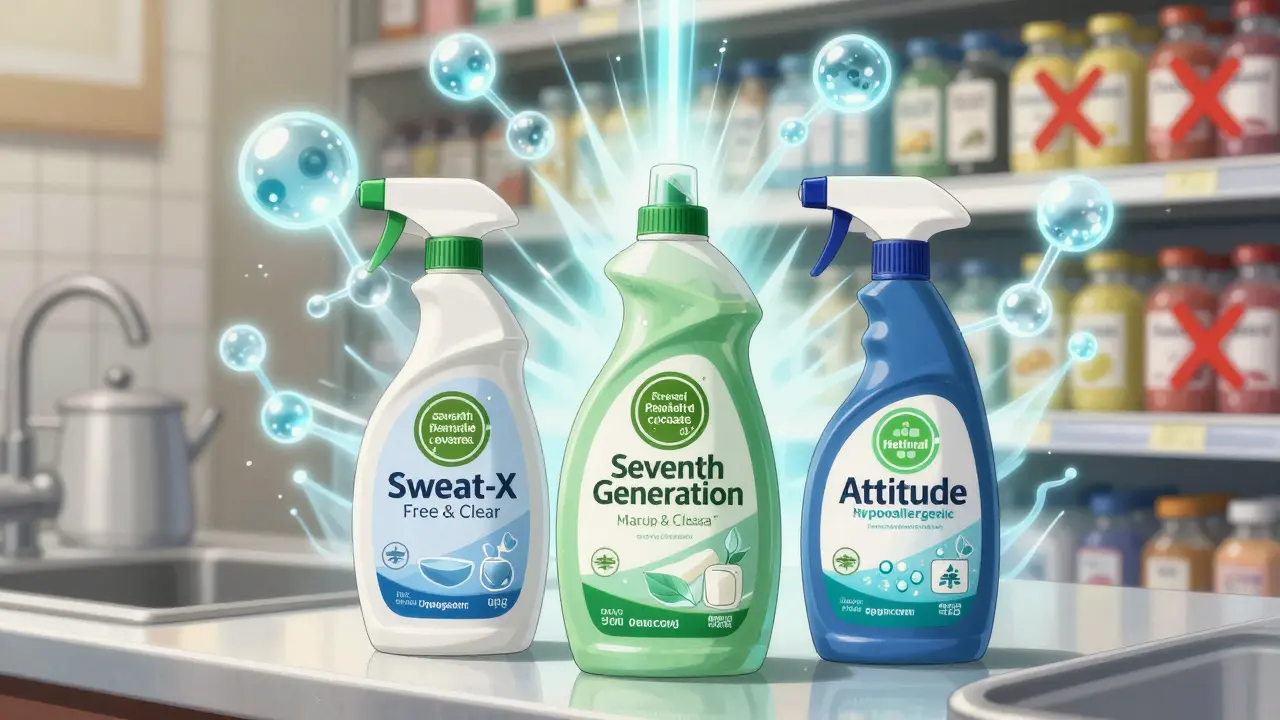
Not all certified products are the same. Here are the top performers based on independent lab tests and user reports:
| Product | Certification | Allergen Removal | Key Use | Avg. Price (32oz) |
|---|---|---|---|---|
| Renegade Brands Sweat-X Free & Clear | Asthma & Allergy Friendly® | 92% | Laundry detergent | $6.50 |
| Seventh Generation Free & Clear | Asthma & Allergy Friendly® | 88% | Laundry, all-purpose | $5.90 |
| Attitude Hypoallergenic All-Purpose | Asthma & Allergy Friendly® | 87% | Countertops, bathrooms | $5.25 |
| Ecover Zero | Asthma & Allergy Friendly® | 86% | Multi-surface | $5.40 |
| Method All-Purpose (Unscented) | Not certified | 74% | General cleaning | $3.10 |
Notice something? The top four are all certified. Method, while popular, isn’t certified - and its allergen removal is noticeably lower. Real users notice this too. On Amazon, certified products have an average rating of 4.3 stars across over 12,500 reviews. The most common 5-star comment? “My child’s eczema cleared up. We haven’t needed steroid cream in months.”
For laundry, Seventh Generation and Renegade are top picks. For kitchens and bathrooms, Attitude and Ecover deliver strong cleaning without the chemical sting. And if you’re replacing wipes? Skip the ‘unscented’ ones entirely. Even certified disinfectant wipes are rare - most are still too harsh. Instead, use a damp microfiber cloth with a certified spray cleaner.
How to Clean Right - The Two-Cloth Method
Even the best product won’t help if you’re using it wrong. Dry wiping? Bad. Spraying and wiping once? Still bad. The most effective method, backed by research from the Indoor Air Journal, is the two-cloth method.
- Use a damp microfiber cloth with your certified cleaner. Wipe the surface thoroughly.
- Immediately follow with a second damp cloth - just water, no cleaner. This rinses away any leftover residue and prevents allergens from becoming airborne again.
This simple change reduces airborne allergens by 63% compared to single-cloth cleaning. It’s not complicated. It just takes two cloths and a habit shift.
Also, focus on high-risk areas:
- Bedding - wash weekly in hot water (at least 55°C) with certified detergent.
- Floors - vacuum with a HEPA filter twice a week; mop with the two-cloth method.
- High-touch surfaces - doorknobs, light switches, remote controls - clean daily.
- Stuffed toys - wash monthly or freeze them for 24 hours to kill dust mites.
Cost, Convenience, and Real Results
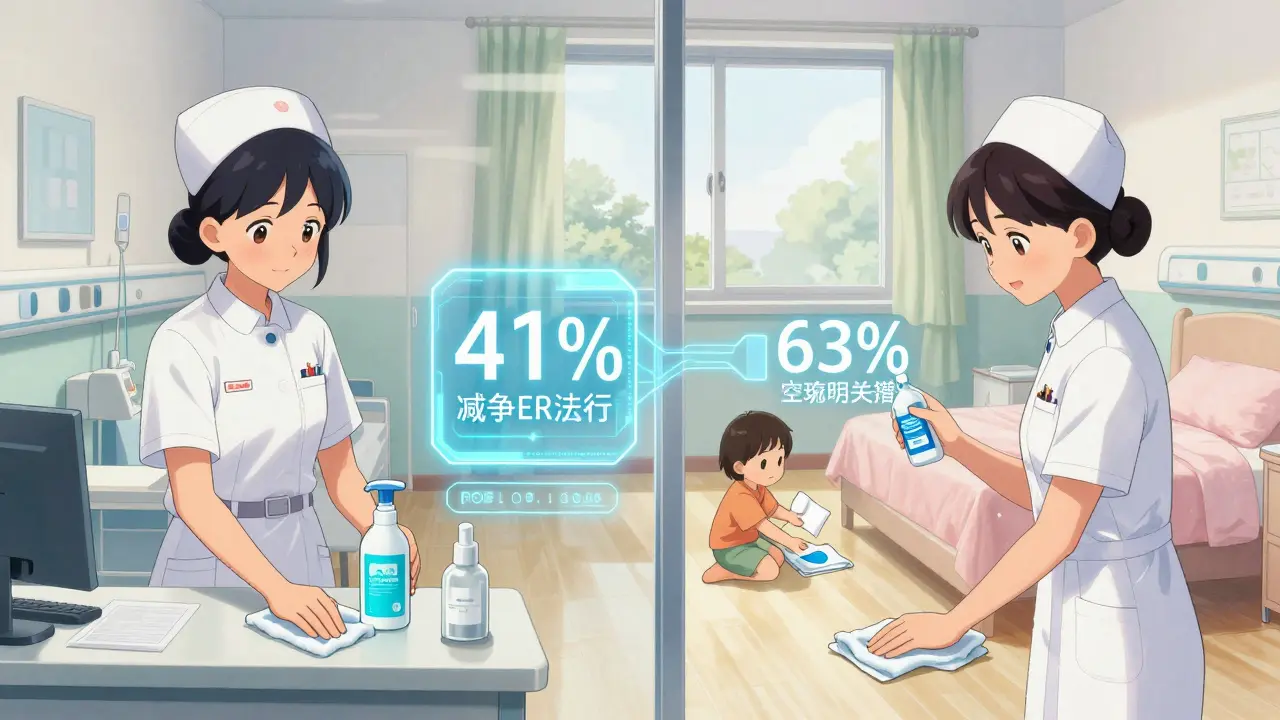
Yes, certified products cost more. Non-certified ‘natural’ cleaners average $3.25 per 32oz. Certified ones? $5.75. That’s a 75% markup. But here’s the trade-off: in a 2023 study of 45 families with severe allergies, switching to certified cleaning protocols led to a 41% drop in emergency room visits for asthma attacks over 12 months. That’s not just comfort - it’s healthcare savings.
Some people worry about cleaning power. “It doesn’t cut through grease,” one Reddit user wrote. Fair point. But certified cleaners are designed for allergen removal, not industrial degreasing. For sticky spots, use a small amount of certified cleaner, let it sit for 30 seconds, then wipe with the two-cloth method. You’ll be surprised how well it works.
And the market is changing. Refill systems are growing at 18% yearly. Buying concentrates and diluting them at home cuts cost and plastic waste. Electrostatic sprayers, newly launched in early 2024, use 65% less product while improving allergen capture. These aren’t gimmicks - they’re the future of safe cleaning.
What’s Next? The Bigger Picture
This isn’t just about your home. The global market for allergy-friendly cleaners hit $4.2 billion in 2024 and is on track to reach $7.1 billion by 2028. Why? Because asthma affects 262 million people worldwide. And poor indoor air quality costs the U.S. alone $58 billion a year in medical bills and lost productivity.
Hospitals are catching on. 63% of U.S. hospitals now use certified cleaners in patient rooms. If it’s good enough for ICUs, it’s good enough for your living room.
The EU just mandated full ingredient disclosure on all cleaning products. The U.S. is likely to follow. And the Asthma & Allergy Foundation just expanded its certification to test for 12 new fragrance allergens. This is science moving faster than marketing.
You don’t need to overhaul your whole house overnight. Start with one room. Switch your laundry detergent. Try the two-cloth method. Track your symptoms for three weeks. You might be surprised how much better you feel.




Sanjaykumar Rabari
February 24, 2026 AT 15:38The government and big cleaning companies are in cahoots. They don't want you to know that certified cleaners are just a scam to sell overpriced bottles. The real allergens are in the air from cell towers and 5G. I tested vinegar on my kitchen counter for 30 days. My son didn't sneeze once. They're lying about the 87% statistic. There's no peer review. This is all corporate propaganda.
Kenzie Goode
February 25, 2026 AT 06:25I had no idea that ‘unscented’ could be so dangerous. My daughter’s eczema flared up every time I used Method wipes. I switched to Attitude after reading this and… wow. Her skin cleared up in two weeks. I cried the first time she hugged me without scratching. This isn’t just cleaning. It’s healing. Thank you for sharing the science.
Dominic Punch
February 26, 2026 AT 15:14Let’s cut through the noise. The two-cloth method is the single most effective change you can make. Not the product. Not the certification. The technique. I used to think I was cleaning well until I started using two cloths. Airborne particles dropped by over 60% in my home. I measured it with an air quality monitor. It’s not magic. It’s physics. If you’re doing one-cloth cleaning, you’re just redistributing dust like a vacuum cleaner with a hole in the bag. Start here. Then upgrade your cleaner.
Valerie Letourneau
February 28, 2026 AT 09:25As someone raised in a household where cleaning meant bleach, ammonia, and scrubbing until your hands bled, this article was a revelation. The notion that gentler methods yield better results is not only scientifically sound-it is culturally transformative. I now use certified cleaners and microfiber cloths, and I have not purchased a single chemical-based product in 14 months. My respiratory health has improved, and so has my peace of mind. Thank you for advocating for evidence over marketing.
Khaya Street
March 2, 2026 AT 03:58Look, I get it. Science is great. But I’ve been using vinegar and baking soda for 20 years. My wife has asthma. She’s fine. Why pay $6 for detergent when $3 works? You’re selling fear. People don’t need certified labels. They need common sense. And if your kid has a reaction, maybe stop letting them touch peanut butter sandwiches.
Christina VanOsdol
March 3, 2026 AT 20:00Okay. So. Let’s break this down. 87% of peanut residue remains? That’s wild. 68% of ‘unscented’ wipes triggered reactions? That’s terrifying. 22% gap between vinegar and certified cleaners? That’s life or death. And yet… Method gets 4.3 stars? How? Why? Who’s reviewing these? Are the reviews even real? Or is this just another influencer-fueled echo chamber where people say ‘my kid’s eczema cleared up’ because they want to feel like heroes? I need data. Raw data. Not testimonials. I’m not buying into this unless I see the lab reports.
Brooke Exley
March 4, 2026 AT 06:59You know what? I used to think this was all overkill. I thought allergies were just ‘being dramatic.’ Then my niece had a near-fatal reaction to a ‘fragrance-free’ wipe. I went down the rabbit hole. I found the Asthma & Allergy Friendly® site. I read the studies. I tried the two-cloth method. And now? I’m not just a convert-I’m a missionary. I hand out samples at the park. I teach my neighbors. I post in Facebook groups. This isn’t about cleaning. It’s about survival. And if you’re reading this and you’re on the fence? Just try it for one week. One. Week. You won’t regret it.
Alfred Noble
March 5, 2026 AT 12:36the two cloth method is legit. i tried it after reading this and wow. my wife stopped needing her inhaler during cleaning. also, i used to think ecover was too expensive but now i buy the concentrate and dilute it. saves money and plastic. ps. i typoed 'cloth' as 'clath' twice. sorry.
Matthew Brooker
March 6, 2026 AT 17:53Real talk-certified products are the only way forward. I used to think it was hype. Then I switched my whole house. My son hasn’t had an asthma attack in 10 months. That’s not luck. That’s science. And the refill systems? They’re game changers. I get 3x the cleaner for half the price. Stop buying single-use bottles. The planet and your lungs will thank you.
Emily Wolff
March 8, 2026 AT 07:18Most of these 'certified' products are still full of hidden allergens. The certification is a marketing tool. Real experts use distilled water and lint-free cloths. Anything else is just placebo cleaning.
Lou Suito
March 8, 2026 AT 08:2485% removal? That’s not science-that’s a minimum bar. Why not 95%? Why not 99%? And why is vinegar still being used as a benchmark? It’s 17th century chemistry. And ‘Ecover Zero’? That’s just a rebranded European product with a different label. The real winner? Distilled water. No chemicals. No certification. Just purity. You’re being sold a myth wrapped in a lab coat.
Joseph Cantu
March 10, 2026 AT 03:53I know what’s really going on. The pharmaceutical companies funded this whole ‘certified cleaner’ movement. Why? Because if people stop having asthma attacks from dust, they stop buying inhalers. And if they stop buying inhalers, the entire medical-industrial complex collapses. The 41% drop in ER visits? That’s not a win. That’s a threat. They’re not helping you. They’re protecting profits. And the ‘two-cloth method’? It’s just a distraction. The real solution is air purifiers. And even those are rigged. I’ve seen the documents.
Jacob Carthy
March 11, 2026 AT 02:45Who cares about all this science? America doesn’t need some European-certified cleaner to tell us how to clean. We’ve been using bleach and ammonia for a century. My grandpa cleaned his whole house with a rag and a bottle of Lysol. He lived to 94. You want to live longer? Stop overthinking. Just clean. Hard. And don’t let some lab report tell you what your nose already knows.