
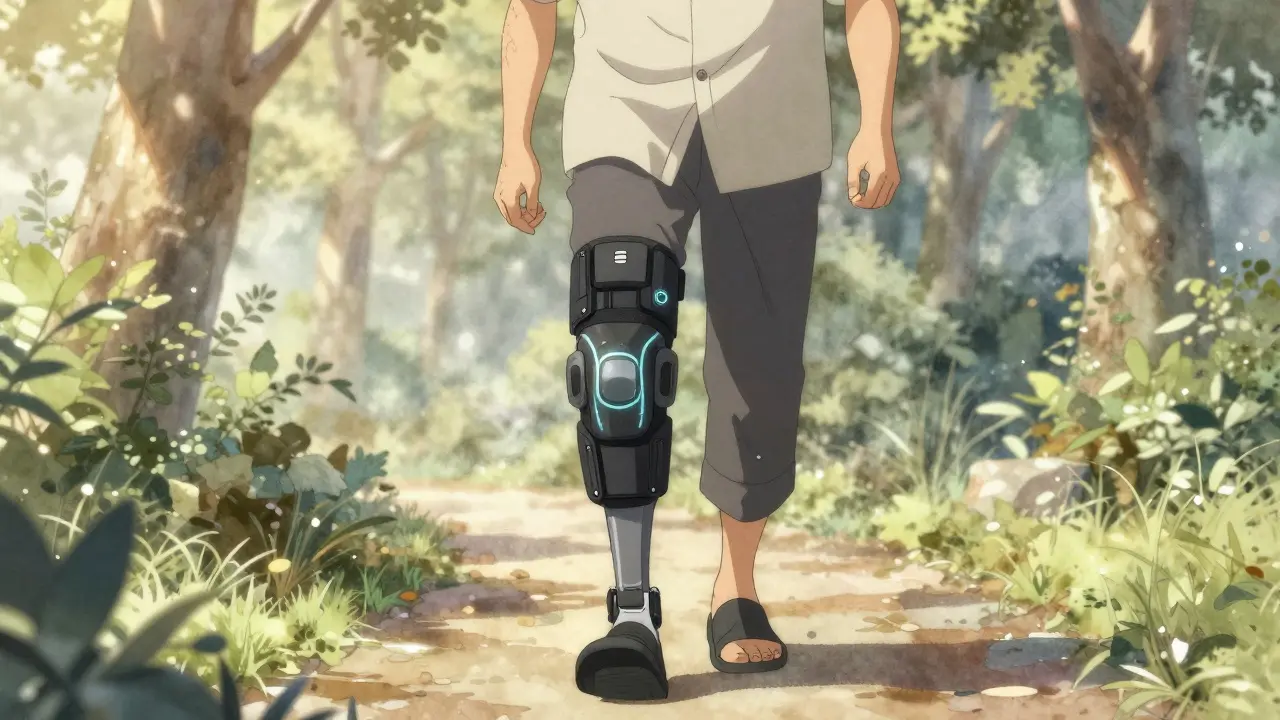
When your knees ache with every step, you’re not just dealing with pain-you’re losing your freedom.
Millions of people over 50 face this daily. Walking to the mailbox, climbing stairs, even standing in line at the grocery store becomes a chore. Knee osteoarthritis isn’t just wear and tear-it’s inflammation, bone rubbing on bone, and muscles too weak to protect the joint. And while surgery is an option, most people want to avoid it. The good news? You don’t have to. Three proven, non-surgical approaches-knee bracing, injections, and exercise-can slash pain, improve mobility, and keep you moving without cutting into your body.
How knee braces take pressure off your joint
Think of a knee brace like a personal weight-shifter. For most people with knee osteoarthritis, the damage is on the inside of the knee-the medial compartment. That’s where most of your body weight presses down when you walk. An unloader brace works by gently tilting your leg to shift that pressure away from the damaged area. It doesn’t fix the cartilage, but it takes the load off it. And that’s enough to make a huge difference.
Studies show these braces reduce pain by 30-45% on standard pain scales. People report being able to walk farther, stand longer, and even sleep better. One 2023 review of over 130 trials found unloader braces ranked highest for pain relief and improved function compared to other non-surgical options. The catch? They have to fit right. A poorly fitted brace can rub, slip, or do nothing at all. That’s why you need a certified orthotist to measure and adjust it. Most people need 2-3 weeks to get used to wearing it, and many say the discomfort fades faster than they expected.
Costs range from $300 to $1,200. Medicare covers 80% if it’s FDA-approved and you have a doctor’s prescription. Insurance often requires prior authorization. If you’ve tried over-the-counter sleeves and felt nothing, don’t give up. A custom unloader brace is a different tool entirely. Real users on Reddit and Amazon report immediate relief during walking-but some complain about bulkiness or skin irritation after hours of wear. If you’re active during the day, wear it only when you need it. Many people take it off at home and put it back on before leaving the house.
What injections can-and can’t-do for your knee
Injections offer fast relief. No waiting weeks. No daily routines. Just a quick office visit and, often, pain reduction within days. But they’re not a cure. They’re a pause button.
The most common types are corticosteroids, hyaluronic acid, and PRP. Corticosteroids are anti-inflammatory shots that calm swelling. They work fast-usually within a few days-and last 4 to 12 weeks. Each shot costs $50-$150, and most doctors limit you to 3-4 per year because too many can damage cartilage over time. Many patients love the quick win. But 32% report rebound pain after the relief fades, which can make the next flare-up feel worse.
Hyaluronic acid (like Gel-Syn 3, newly FDA-approved in 2023) acts like synthetic joint fluid. It’s thicker and more lubricating. A full course is 3-5 weekly injections, costing $500-$1,200 total. Newer versions now last up to 22 weeks. That’s longer than most people expect. But studies show it doesn’t work for everyone. If you’ve tried it before and felt nothing, you’re not alone. About 40% of patients see clear improvement. It’s best for mild to moderate OA, not bone-on-bone cases.
PRP (platelet-rich plasma) uses your own blood. It’s drawn, spun to concentrate healing cells, then injected. Costs range from $500 to $2,000 and usually aren’t covered by insurance. Evidence is mixed. Some patients swear by it. Others feel nothing. It’s not yet a standard recommendation from major guidelines, but it’s gaining traction as a middle ground between steroids and surgery.
The biggest downside? Pain during the shot. Over half of negative reviews mention the procedure itself as uncomfortable. There’s also a tiny risk-0.1% to 0.7%-of infection. That’s rare, but serious. Always get injections from a licensed provider who uses sterile technique. And never rely on them alone. If you skip exercise after an injection, your muscles weaken, and your knee becomes more dependent on the shot. That’s a trap.

Exercise: the slow burn that changes everything
If you’ve ever been told to “just exercise more” for knee pain, you probably rolled your eyes. It sounds like advice from someone who’s never had a bad knee. But here’s the truth: exercise isn’t about running marathons. It’s about rebuilding the support system around your knee.
When cartilage wears down, your muscles become your shock absorbers. Weak quads and hamstrings mean more stress on the joint. Strengthening them-even gently-can reduce pain by 20-30%. Water-based exercises like swimming or water aerobics are especially powerful. One study showed 28.7% pain reduction on a visual scale after 12 weeks in the pool, compared to 22.3% with land-based workouts. The water supports your weight, so your knee doesn’t have to carry the load while you’re moving.
Land-based exercises like seated leg lifts, heel slides, and mini-squats against a wall are just as important. You don’t need equipment. A chair, a towel, and 15 minutes a day are enough to start. Stretching improves flexibility. One meta-analysis found consistent daily stretching added 8.2 degrees to your knee’s range of motion after 6-8 weeks. That might not sound like much, but it means you can bend down to tie your shoes without groaning.
Adherence is the real challenge. Only 48% of people stick with exercise after a year. Why? It’s slow. You don’t feel a magic fix after one session. But the payoff is bigger than any injection. After 12 months, people who stick with exercise see 32.5% improvement in daily function-far better than injections alone. And it helps other joints too. Many users say their hips and lower back feel better because they’re moving better overall.
Start with a physical therapist for the first 4-6 weeks. They’ll teach you how to do the moves safely. Then, you can continue at home. The Arthritis Foundation’s program is free, well-reviewed, and designed for beginners. You don’t need to go to the gym. Just move daily-even if it’s just walking around the block.
Why combining all three works better than any one alone
Here’s what the experts agree on: no single treatment is perfect. But together? They’re powerful.
Think of it like this: bracing gives you immediate relief so you can move without pain. Injections give you a boost when pain flares up-say, after a long day or bad weather. Exercise builds the strength and flexibility that keep the pain from coming back.
Dr. Tuhina Neogi, a leading arthritis researcher, calls this the “combination therapy” approach. It’s not just logical-it’s backed by data. Patients who use bracing and exercise together report better outcomes than those who do just one. Adding injections for flare-ups means you’re not stuck waiting for pain to fade on its own.
And here’s the kicker: using all three reduces your chances of needing surgery. A 2022 health economics study found that multimodal non-surgical care costs $12,500-$18,700 per quality-adjusted life year gained. Total knee replacement? $35,600. That’s nearly triple the cost-and it’s irreversible.
Some orthopedic surgeons warn against overusing injections without exercise. They say if you rely on shots and sit still, your muscles shrink, your joint stiffens, and you end up worse off. That’s why the best plan includes movement every day-even on injection days.

What to do next: a simple plan for real results
You don’t need to do everything at once. Start small. Pick one thing that feels doable.
- Try a brace first if walking hurts badly. Visit an orthotist. Ask your doctor for a referral. Wear it for 30 minutes a day at first. Build up to full use.
- Start walking daily. Even 10 minutes counts. If your knee flares up, try water exercises. Look for a local pool program for arthritis-many YMCAs and community centers offer them.
- Consider an injection if pain spikes. Don’t use it as a regular fix. Save it for bad days. Ask your doctor about corticosteroids first-they’re affordable and fast.
- Track your progress. Rate your pain on a scale of 1-10 every week. Notice what helps. Did walking after your brace feel easier? Did the injection give you a week of good sleep? Write it down.
Don’t wait for pain to get worse. The earlier you act, the more control you keep. Most people who stick with this plan don’t need surgery. They just get their lives back.
Common questions about knee osteoarthritis treatments
Are knee braces worth it for osteoarthritis?
Yes, if you have medial compartment OA-the most common type. Unloader braces reduce pain by 30-45% and improve walking ability. They’re not magic, but they’re one of the most effective non-drug treatments. Make sure it’s fitted by a professional. Over-the-counter sleeves won’t cut it.
How often can I get knee injections?
Corticosteroid injections should be limited to 3-4 times per year to avoid cartilage damage. Hyaluronic acid can be repeated annually, especially with newer formulations that last longer. PRP has no strict limit, but insurance rarely covers it more than once. Always pair injections with exercise to maintain joint strength.
Can exercise make knee osteoarthritis worse?
Only if you do high-impact moves like running or jumping. Low-impact exercise-walking, swimming, cycling, seated leg lifts-strengthens the muscles around your knee and reduces pain. Avoid anything that causes sharp pain. A little soreness is normal. A sudden spike in pain is not.
Is PRP better than corticosteroid injections?
Not necessarily. PRP is more expensive and not covered by most insurance. Studies show mixed results-some people feel great, others feel nothing. Corticosteroids work faster and are proven to reduce inflammation. PRP may help with long-term healing, but evidence isn’t strong enough yet to call it superior. Talk to your doctor about your goals.
How long does it take for exercise to help knee pain?
Most people notice small improvements in 4-6 weeks. Significant pain reduction and better function usually take 12-16 weeks of consistent effort. The key is daily movement-even 10-15 minutes. Don’t wait for big results. Celebrate small wins: walking farther, climbing stairs without help, sleeping through the night.
What to avoid
Don’t wait until you can’t walk to act. Don’t assume injections are a long-term fix. Don’t skip exercise because you think it won’t help. And don’t believe the myth that “your knee is just worn out.” Your body is still capable of healing-if you give it the right tools.
Knee osteoarthritis doesn’t have to mean giving up. With the right mix of bracing, smart injections, and daily movement, you can stay active, independent, and pain-free-for years to come.




Bryan Anderson
January 1, 2026 AT 18:42I've been using an unloader brace for about six months now, and while it took a few weeks to get used to, the difference in my daily mobility has been remarkable. I can walk to the corner store without wincing, and I no longer need to plan my day around knee pain. The key is getting it fitted properly-don’t skip the orthotist. Also, pairing it with light daily stretching made the brace feel less like a crutch and more like a tool.
Matthew Hekmatniaz
January 3, 2026 AT 02:37It’s fascinating how often we overlook the body’s ability to adapt when given the right support. Bracing doesn’t heal cartilage, but it gives the joint space to rest-and that’s often all it needs. Exercise, even gentle, is the quiet hero here. I’ve seen people go from barely walking to hiking again, not because their knees magically regenerated, but because their muscles learned to carry the load better.
Liam George
January 3, 2026 AT 10:12Let’s be real-this whole ‘non-surgical solution’ narrative is a distraction. Big Pharma and ortho-industrial complex want you to believe you can ‘manage’ OA forever, but the truth? They’re milking you. Braces? Expensive. Injections? Temporary. Exercise? A chore. Meanwhile, the real solution-stem cell clinics, regenerative tech, even CRISPR-is being buried because it’s not profitable. They don’t want you cured. They want you subscribed.
sharad vyas
January 3, 2026 AT 16:25In my village, we say: ‘The body remembers what the mind forgets.’ Walking, even slowly, is prayer for the knees. No brace, no shot-just movement, patience, and respect. I know a man, 78, who walks 2 miles every morning. He says his knees don’t hurt because he never stopped listening to them.
Dusty Weeks
January 3, 2026 AT 17:34braces are sooo bulky 😩 but the injection i got last month? absolute game changer. i cried it felt so good to walk without screaming. also, i did 5 mins of leg lifts and now i’m basically a superhero 🦸♂️✨
Sally Denham-Vaughan
January 5, 2026 AT 06:48So many people think exercise means running or lifting weights-but nope. It’s just moving. I started doing seated marches while watching TV. Five minutes a day. Now I can get out of my chair without groaning. It’s not glamorous, but it’s real. Also, water aerobics is the most fun you’ll have while sweating and not realizing it.
Bill Medley
January 6, 2026 AT 17:36Combination therapy is clinically superior. Evidence supports multimodal intervention. Exercise enhances brace efficacy. Injections provide temporal relief. Avoid monotherapy. Consistency yields outcomes. Recommend structured program. Document progress.
Donna Peplinskie
January 8, 2026 AT 05:49Bracing, yes-but only if it's fitted correctly; injections, maybe-but only sparingly, and always with movement; exercise, absolutely-but only if it's done gently, daily, and without pushing through pain... and please, please, please, don't skip the physical therapist... it makes all the difference.
Olukayode Oguntulu
January 8, 2026 AT 13:05How quaint. You speak of braces and injections as if they’re acts of wisdom. But the real truth? Your knee is a relic of industrialized living-sedentary, overfed, disconnected from natural rhythm. You think a brace will fix what your lifestyle broke? The answer isn’t in orthotics or pharma-it’s in barefoot walking, ancestral movement, and silence. But that’s too inconvenient for the modern mind, isn’t it?