
When you pick up a generic pill at the pharmacy, you expect it to work just like the brand-name version. But what if it doesn’t? Behind many generic drug failures are hidden problems in manufacturing plants - problems that can affect how well a medicine works, or even put your health at risk.
What Goes Wrong in Generic Drug Factories?
Generic drugs are supposed to be exact copies of brand-name drugs. They must contain the same active ingredient, in the same strength, and work the same way in your body. But that’s not always what happens. The biggest cause of failure? Current Good Manufacturing Practices (cGMP) violations. These are the rules that factories must follow to make sure every pill is safe, pure, and effective.When factories cut corners, things go wrong. Common issues include:
- Contaminated raw materials - like active ingredients that contain toxic impurities
- Improper storage - heat or moisture ruining the drug before it reaches you
- Bad testing - labs skipping tests or falsifying results
- Inconsistent dosing - some pills have too much or too little medicine
- Unreliable packaging - pills that break down too fast or absorb moisture
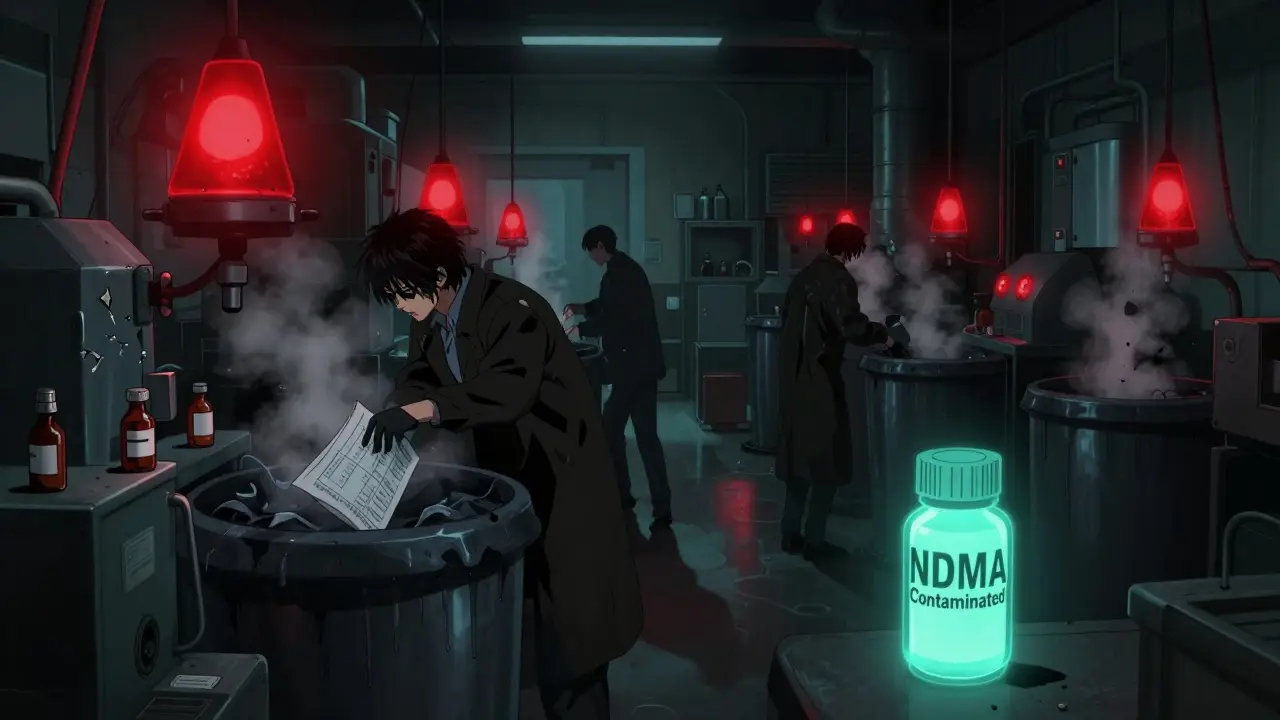
One of the most shocking cases happened in 2018. The FDA found N-nitrosodimethylamine (NDMA), a known cancer-causing chemical, in blood pressure meds like valsartan. The source? A factory in China. Over 2.1 million patients were exposed. That wasn’t a one-off. Between June 2018 and October 2019, 28 different generic drugs were voluntarily recalled due to similar impurities.
Why Are Foreign Factories the Main Problem?
Eighty percent of the raw ingredients in U.S. drugs come from overseas - mostly China and India. Forty percent of finished pills are made there too. But here’s the catch: the FDA can’t inspect these places the same way it inspects U.S. factories.In America, inspections are unannounced. Inspectors show up without warning, check equipment, review logs, and even look at trash bins to see if documents are being destroyed. In China and India? Factories get notice weeks in advance. They clean up. They train staff to give rehearsed answers. They hide problems.
Data from 2022 shows U.S. facilities averaged 4.2% fewer inspection violations than foreign ones. Chinese factories had 28.6% more violations. Indian ones had 19.3% more. A 2023 study found generic drugs made in India led to 23.7% more serious side effects than those made in the U.S.
And it’s not just about inspections. The FDA only tests 0.02% of imported drug shipments in labs. That’s 1 in 5,000. The rest? They’re approved based on paperwork - not real-world testing.
What Kind of Defects Actually Matter?
Not all quality issues are the same. Some are harmless. Others can kill you.Critical Quality Attributes (CQAs) are the measurable traits that determine if a drug works. If these aren’t controlled, the medicine fails. For example:
- Nitrosamine impurities - cancer-causing chemicals found in heart and diabetes drugs
- Dissolution rates - how fast the pill breaks down in your stomach. Too slow? It won’t work. Too fast? You get a dangerous overdose
- Stability data - if a drug degrades in heat, but no one tested it, you might get a useless or dangerous pill
- Therapeutic equivalence - for drugs like warfarin or levothyroxine, even a 5% difference can cause a stroke or thyroid crisis
Take nitroglycerin - used during heart attacks. In 2019-2022, 14.3% of all FDA reports about generic drug failures came from one maker: Impax Laboratories. Their tablets didn’t dissolve properly. People got chest pain. Some had heart attacks because the medicine didn’t work fast enough.
Narrow Therapeutic Index (NTI) drugs - like tacrolimus, used after organ transplants - are especially dangerous. A 2021 study in JAMA found generic tacrolimus had 28.4% more variation in blood levels than the brand version. That’s not a small difference. It means some patients got too much and had kidney damage. Others got too little and rejected their new organs.
Why Don’t More Factories Fix This?
The answer? Money.Generic drug prices have dropped 18.3% every year since 2018. To stay profitable, manufacturers slash costs. That means:
- Reducing quality control budgets by 22.7%
- Hiring undertrained staff
- Skipping stability tests
- Using cheaper, untested raw materials
Implementing a real quality system - called Quality by Design (QbD) - costs $2.7 million per plant and takes 18 to 24 months. Only 23.8% of generic manufacturers have done it. The rest? They’re playing Russian roulette with your health.
Even worse, data integrity is a mess. FDA inspections found 78.3% of data problems came from:
- Employees deleting electronic records
- Not using audit trails
- Sharing passwords
In one case, an employee at an Indian plant was caught pouring acid into a trash can full of quality control documents. That’s not a mistake. That’s sabotage.
What’s Being Done - And Is It Enough?
The FDA issued 147 warning letters in 2022 - up 28.5% from 2021. Sixty-three percent targeted foreign plants. The agency got $56.7 million extra in 2022 to improve foreign inspections. By 2027, they aim to inspect 1,800 foreign plants a year - up from 1,200.But that’s still not enough. There are nearly 3,000 foreign facilities making drugs for the U.S. The FDA inspects only 13% of them each year. That’s one inspection every 7 years per plant - if they’re lucky.
Europe took a harder line. Since January 2023, the European Medicines Agency does unannounced inspections on all foreign suppliers. Result? A 41.2% spike in critical findings. That’s proof: surprise visits work.
The FDA’s 2023-2027 plan says it will focus on high-risk facilities - the ones making NTI drugs or complex formulations. But until they can inspect without warning and test more samples, the risk stays high.
What Should You Do?
You can’t control the factory. But you can protect yourself.- Ask your pharmacist where your generic drug is made. If it’s from a plant with past FDA warnings, ask if a brand version is available.
- Monitor side effects - if a generic suddenly stops working or causes new symptoms, report it. Use the FDA’s MedWatch system.
- Check recalls - visit the FDA’s website monthly. They list all recalled drugs.
- For critical meds - like thyroid, blood thinners, or seizure drugs - stick with the brand if you can afford it. The difference in consistency could save your life.
Most generics are safe. But when quality breaks down, it’s not a statistical anomaly - it’s a human cost. People get sick. People die. And the factories that make these drugs? They’re still making them - because the system lets them.
Are all generic drugs unsafe?
No. Most generic drugs are safe and effective. But the risk is higher with drugs made in facilities with a history of FDA violations, especially for critical medications like blood thinners, thyroid hormones, or epilepsy drugs. Always check the manufacturer and recall history.
How can I find out where my drug is made?
Look at the drug label - it lists the manufacturer. Search that name on the FDA’s website or use the Drugs.com database. Many manufacturers have public inspection histories. If the facility had a warning letter in the last 3 years, consider asking your doctor for an alternative.
Why does the FDA allow drugs from bad factories to stay on the market?
The FDA doesn’t always know. Many violations go undetected because inspections are scheduled in advance, and lab testing is extremely rare. Even when problems are found, removing a drug from the market can cause shortages - so the agency often gives companies time to fix issues instead of pulling the product immediately.
Do U.S.-made generics have fewer problems?
Yes. U.S. facilities have 4.2% fewer FDA inspection violations than foreign ones. They’re also subject to unannounced inspections and stricter data integrity rules. For life-saving drugs, choosing a U.S.-made generic significantly reduces your risk.
What should I do if I think my generic drug isn’t working?
Don’t stop taking it without talking to your doctor. But do report it. Contact your pharmacist, ask if there’s been a recall, and file a report with the FDA’s MedWatch system. If you’re on a critical medication like warfarin or levothyroxine, ask about switching to the brand name or a different generic manufacturer.
What’s Next?
The pressure is building. More patients, pharmacists, and doctors are asking questions. The FDA is under fire. And with drug shortages still rising - 58.7% of them in 2022 tied to foreign plant failures - change is coming.But it won’t come fast enough for everyone. Until inspections are truly random, until labs test more than 1 in 5,000 shipments, and until manufacturers stop treating quality as a cost to cut - the risk remains. You can’t control the factory. But you can control what you ask for - and what you refuse to accept.


Lauren Volpi
March 16, 2026 AT 12:55So let me get this straight - we’re trusting our lives to pills made in factories where the inspectors get a heads-up like it’s a birthday party? 😑
Meanwhile, my blood pressure med came from a plant that got cited for ‘missing trash bin audits.’ Like, what even is that? Are they dumpster-diving for evidence now?
Kendrick Heyward
March 17, 2026 AT 15:08My grandma died because her generic warfarin didn’t dissolve right. She didn’t even know she was on a bad batch. The pharmacy didn’t tell her. The FDA didn’t tell her. Nobody told her. And now? We’re all just supposed to ‘check the label’ like it’s a cereal box.
People are dying. And we’re still shopping on price. 💔
Kal Lambert
March 17, 2026 AT 22:41U.S.-made generics are way safer. Period.
Inspections are random. Data trails are locked. Labs test more.
If you’re on a critical med - thyroid, seizure, transplant - spend the extra $5. It’s not greed. It’s survival.
jared baker
March 18, 2026 AT 22:38Just check the manufacturer name on the bottle. Look it up on the FDA site. If it has a warning letter in the last 3 years, ask for another brand.
Easy. No drama. Just do it.
Michelle Jackson
March 20, 2026 AT 18:47They say 80% of our drug ingredients come from India and China. But they don’t say that 90% of those places have employees who get paid $2 a day to press buttons and ignore red lights.
It’s not a quality issue. It’s a slavery issue. And we’re the ones buying it.
Suchi G.
March 22, 2026 AT 11:42As someone from India, I’m hurt. Yes, some factories cut corners - but not all. We have world-class labs in Hyderabad and Ahmedabad. Many Indian manufacturers follow EU standards. Why do you only hear about the bad ones?
It’s easier to blame us than fix your own system. The FDA doesn’t have enough inspectors. That’s the real problem.
And yes, I’ve seen U.S. plants with broken air filters too. Don’t act like this is a foreign problem.
becca roberts
March 22, 2026 AT 21:28Oh wow, so the FDA lets drugs in based on paperwork? Shocking.
Wait - didn’t we just do that with PPE during COVID? And now we’re mad when the same system kills people?
Maybe the real issue isn’t India. It’s that we treat medicine like Amazon Prime.
Paul Ratliff
March 23, 2026 AT 00:20my doc switched me to a us-made generic last year. no more dizziness. no more weird crashes. just… works.
who knew the difference was that simple?
Gaurav Kumar
March 24, 2026 AT 13:34India produces 40% of the world’s generic drugs. We are not a third-world factory. We are a pharmaceutical powerhouse.
Our scientists design formulations that save millions. Your FDA inspections are outdated. You inspect like it’s 2008. We’ve moved to AI-driven QA systems.
Stop using fear to sell fear. The truth? India makes better generics than most U.S. companies - and they do it cheaper.
David Robinson
March 25, 2026 AT 07:20Here’s the truth nobody wants to admit: we’re addicted to cheap drugs. We don’t care if someone in Bangalore is working 18-hour shifts to meet quotas. We just want our $4 prescriptions.
So we get what we deserve - a system that lets cancer-causing chemicals slip through because the FDA is underfunded and the pharma giants are too busy lobbying to care.
And now we’re surprised people are dying?
Pathetic.
Jeremy Van Veelen
March 25, 2026 AT 07:45I read this article and I cried.
Not because of the data.
Not because of the statistics.
But because I know someone who took a generic version of levothyroxine and went into thyroid storm. She was 27. She had a 3-year-old.
Her pharmacy didn’t know. Her doctor didn’t know. The FDA didn’t know.
And now? She’s on life support.
Who do we blame? The factory? The regulator? The consumer who chose the $3 option?
We all did.
Aileen Nasywa Shabira
March 25, 2026 AT 19:49Oh look, another article blaming India while ignoring that 70% of U.S. drug plants have had FDA violations too.
It’s not about geography. It’s about profit. And guess who’s making it? The same corporations that own both the brand-name AND the generic versions.
They don’t want quality. They want compliance loopholes.
Stop the performative outrage. This is capitalism. Not conspiracy. Just greed.
lawanna major
March 27, 2026 AT 18:24What if we stopped treating medicine like a commodity and started treating it like a human right?
Not every drug should be sold on price. Some - like those that keep you alive - should be treated like clean water or electricity.
Maybe we don’t need more inspections.
Maybe we need a new moral framework.
Because right now, we’re choosing cost over life - and calling it ‘affordability.’
That’s not progress. That’s moral decay.
Ryan Voeltner
March 27, 2026 AT 22:20While the systemic issues described are valid and deeply concerning, the proposed solutions must be grounded in evidence-based policy reform rather than emotional appeals.
Increased unannounced inspections, mandatory audit trails, and standardized global cGMP benchmarks are necessary.
However, the assertion that U.S.-made generics are inherently superior lacks comprehensive comparative data.
Quality must be measured by outcomes, not origin.